Moz Q&A is closed.
After more than 13 years, and tens of thousands of questions, Moz Q&A closed on 12th December 2024. Whilst we’re not completely removing the content - many posts will still be possible to view - we have locked both new posts and new replies. More details here.
Schema markup for products is missing "price": Is this bad?
-
Hey guys,
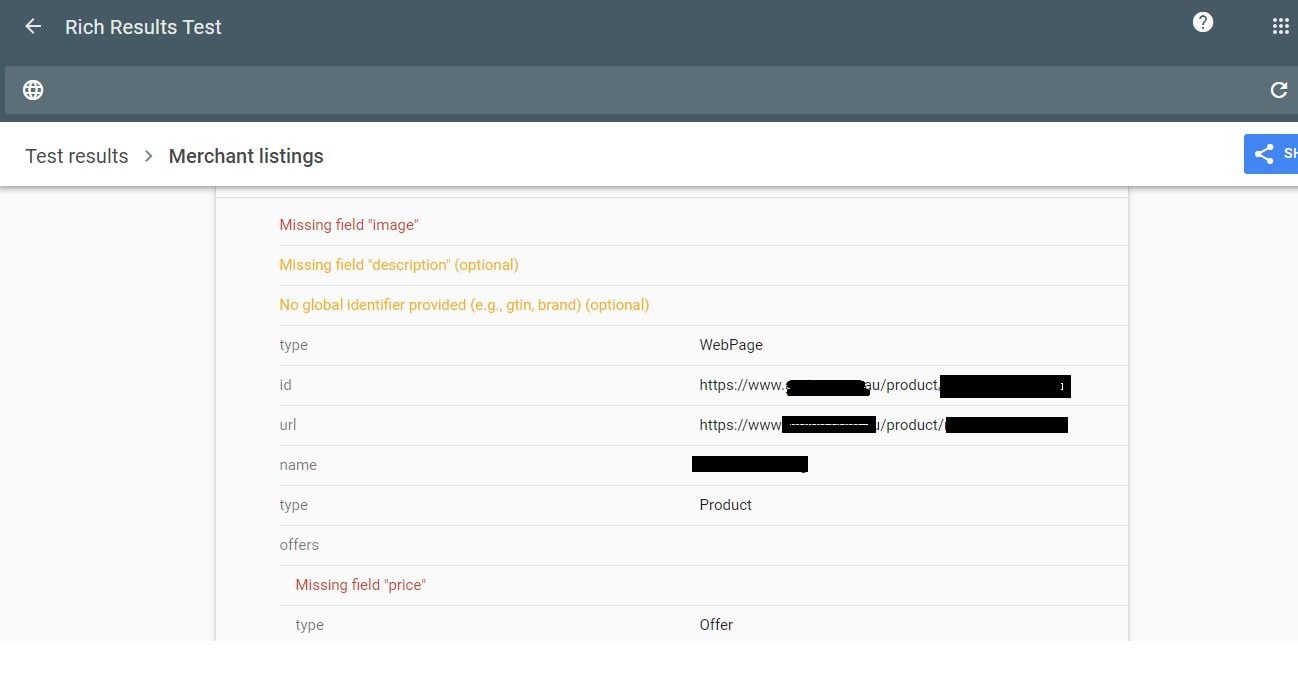
So a current client of mine has an e-commerce shop with a few hundred products. They purposely choose to keep the prices off of their website, which is causing errors in Google Webmaster Tools.
Basically the error shows:
Error: Structured Data > Product (markup: schema.org)
Error type: missing price
208 items with error
Is this a huge deal? Or are we allowed to have non-numerical prices for schema ie. "call for quote"
-
Hello,
It sounds like you are receiving this error because you have the markup for price in the html, but it is not finding the price so it is showing the error. If you remove the schema markup for the price it will still be valid and should no longer show the error.
We have a similar setup on a client's site of ours. They offer multiple versions of their product in different versions and we do not markup the price using schema, only the ratings and these show up perfectly fine in the SERPS. You can also check Google's Structured Data Testing Tool to aid in schema implementation.
As for a price other then a numerical value, looks like that is possible according to schema.org.

Got a burning SEO question?
Subscribe to Moz Pro to gain full access to Q&A, answer questions, and ask your own.
Browse Questions
Explore more categories
-
Moz Tools
Chat with the community about the Moz tools.
-
SEO Tactics
Discuss the SEO process with fellow marketers
-
Community
Discuss industry events, jobs, and news!
-
Digital Marketing
Chat about tactics outside of SEO
-
Research & Trends
Dive into research and trends in the search industry.
-
Support
Connect on product support and feature requests.
Related Questions
-
Page with "random" content
Hi, I'm creating a page of 300+ in the near future, on which the content basicly will be unique as it can be. However, upon every refresh, also coming from a search engine refferer, i want the actual content such as listing 12 business to be displayed random upon every hit. So basicly we got 300+ nearby pages with unique content, and the overview of those "listings" as i might say, are being displayed randomly. Ive build an extensive script and i disabled any caching for PHP files in specific these pages, it works. But what about google? The content of the pages will still be as it is, it is more of the listings that are shuffled randomly to give every business listing a fair shot at a click and so on. Anyone experience with this? Ive tried a few things in the past, like a "Last update PHP Month" in the title which sometimes is'nt picked up very well.
Technical SEO | | Vanderlindemedia0 -
Product schema GSC Error 'offers, review, or aggregateRating should be specified'
I do not have a sku, global identifier, rating or offer for my product. Nonetheless it is my product. The price is variable (as it's insurance) so it would be inappropriate to provide a high or low price. Therefore, these items were not included in my product schema. SD Testing tool showed 2 warnings, for missing sku and global identifier. Google Search Console gave me an error today that said: 'offers, review, or aggregateRating should be specified' I don't want to be dishonest in supplying any of these, but I also don't want to have my page deprecated in the search results. BUT I DO want my item to show up as a product. Should I forget the product schema? Advice/suggestions? Thanks in advance.
Technical SEO | | RoxBrock1 -
Schema.org product offer with a price range, or multiple offers with single prices?
I'm implementing Schema.org, (JSON-LD), on an eCommerce site. Each product has a few different variations, and these variations can change the price, (think T-shirts, but blue & white cost $5, red is $5.50, and yellow is $6). In my Schema.org markup, (using JSON-LD), in each Product's Offer, I could either have a single Offer with a price range, (minPricd: $5, maxPrice $6), or I could add a separate Offer for each variation, each with its own, correct, price set. Is one of these better than the other? Why? I've been looking at the WooCommerce code and they seem to do the single offer with a price range, but that could be because it's more flexible for a system that's used by millions of people.
Technical SEO | | 4RS_John1 -
Event Schema markup for multiple events (same location/address)?
I was wondering if its possible to markup multiple events on the same page for one location/address using the event schema.org markup? I tried doing it on a sample page below: http://www.rama.id.au/event-schema-test/ Google's schema testing tool shows that its all good (except for warning for offers). Just wanted to know if I am doing it correctly or is there a better solution. Any help would be much appreciated. Thank you 🙂
Technical SEO | | Vsood0 -
How do you mark a quote HTML wise?
Hi, As far as I know, in the past Italic was used to emphasize (similar use to Bold). Now I've seen people use Italic for quotations. Is that the correct thing to do for an entire paragraph or is it a problem for Google wise? Thanks
Technical SEO | | BeytzNet0 -
Hyphenated Domain Names - "Spammy" or Not?
Some say hyphenated domain names are "spammy". I have also noticed that Moz's On Page Keyword Tool does NOT recognize keywords in a non-hyphenated domain name. So one would assume neither do the bots. I noticed obviously misleading words like car in carnival or spa in space or spatula, etc embedded in domain names and pondered the effect. I took it a step further with non-hyphenated domain names. I experimented by selecting totally random three or four letter blocks - Example: randomfactgenerator.net - rand omf act gene rator Each one of those clips returns copious results AND the On-Page Report Card does not credit the domain name as containing "random facts" as keywords**,** whereas www.business-sales-sarasota.com does get credit for "business sales sarasota" in the URL. This seems an obvious situation - unhyphenated domains can scramble the keywords and confuse the bots, as they search all possible combinations. YES - I know the content should carry it but - I do not believe domain names are irrelevant, as many say. I don't believe that hyphenated domain names are not more efficient than non hyphenated ones - as long as you don't overdo it. I have also seen where a weak site in an easy market will quickly top the list because the hyphenated domain name matches the search term - I have done it (in my pre Seo Moz days) with ft-myers-auto-air.com. I built the site in a couple of days and in a couple weeks it was on page one. Any thoughts on this?
Technical SEO | | dcmike0 -
Use of + in url good or bad?
Hi, I am working on a SEO project for a client.
Technical SEO | | MaartenvandenBos
Some of the urls have a + between the keyword.
like www.example.com/make+me+happy/ Is this good or bad for seo?
Or is it maybe better to use - ? Thanks!0 -
Which pages to "noindex"
I have read through the many articles regarding the use of Meta Noindex, but what I haven't been able to find is a clear explanation of when, why or what to use this on. I'm thinking that it would be appropriate to use it on: legal pages such as privacy policy and terms of use
Technical SEO | | mmaes
search results page
blog archive and category pages Thanks for any insight of this.0