Moz Q&A is closed.
After more than 13 years, and tens of thousands of questions, Moz Q&A closed on 12th December 2024. Whilst we’re not completely removing the content - many posts will still be possible to view - we have locked both new posts and new replies. More details here.
Schema Markup Warning "Missing field "url" (optional)"
-
Hello Moz Team, I hope everyone is doing well & good,
I need bit help regarding Schema Markup, I am facing issue in my schema markup specifically with my blog posts,
In my majority of the posts I find error "Missing field "url" (optional)"
As this schema is generated by Yoast plugin, I haven't applied any custom steps.Recently I published a post
https://dailycontributors.com/kisscartoon-alternatives-and-complete-review/
and I tested it at two platforms of schema test
1, Validator.Schema.org
2. Search.google.com/test/rich-resultsSo the validator generate results as follows and shows no error
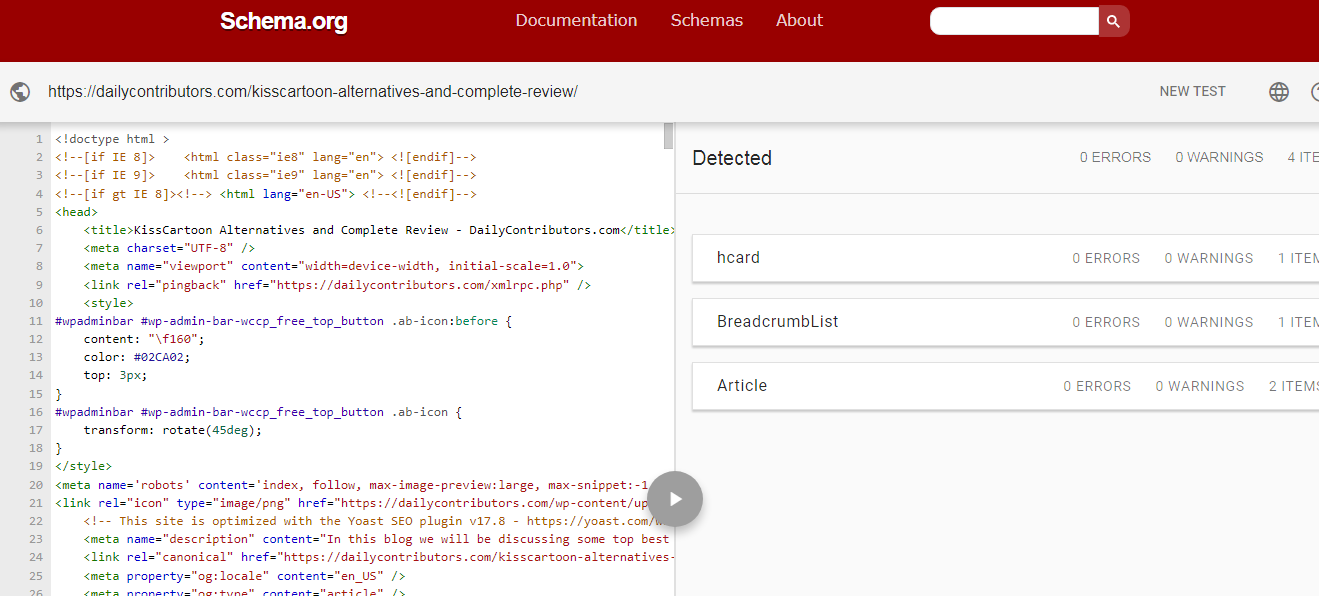
It shows no error
But where as
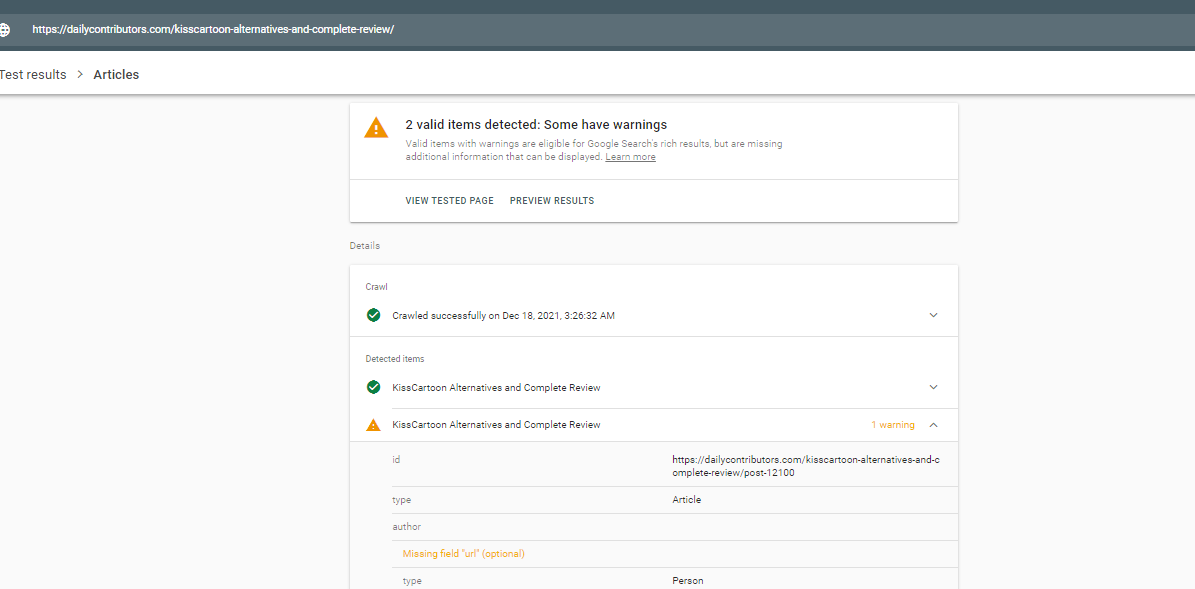
in search central results it gives me a warning "Missing field "url" (optional)".
So is this really be going to issue for my ranking ? Please help thanks!
-
@JoeySolicitor I thinks , My website sam with your issue

Got a burning SEO question?
Subscribe to Moz Pro to gain full access to Q&A, answer questions, and ask your own.
Browse Questions
Explore more categories
-
Moz Tools
Chat with the community about the Moz tools.
-
SEO Tactics
Discuss the SEO process with fellow marketers
-
Community
Discuss industry events, jobs, and news!
-
Digital Marketing
Chat about tactics outside of SEO
-
Research & Trends
Dive into research and trends in the search industry.
-
Support
Connect on product support and feature requests.
Related Questions
-
What Schema would a Web design/development/seo ageny use and what is the schema.org link?
What Schema would a Web design/development/SEO Ageny use, and what is the schema.org link? I cannot for the life of me figure it out. ProfessionalService has been deprecated.
On-Page Optimization | | TiagoPedreira0 -
Unsolved Duplicate LocalBusiness Schema Markup
Hello! I've been having a hard time finding an answer to this specific question so I figured I'd drop it here. I always add custom LocalBusiness markup to clients' homepages, but sometimes the client's website provider will include their own automated LocalBusiness markup. The codes I create often include more information. Assuming the website provider is unwilling to remove their markup, is it a bad idea to include my code as well? It seems like it could potentially be read as spammy by Google. Do the pros of having more detailed markup outweigh that potential negative impact?
Local Website Optimization | | GoogleAlgoServant0 -
Looking for live web examples of Medical schema
Has anyone seen a hospital system or medical clinic properly employ schema markup to their sites? This seems like very new territory, and we want to do it right by our client. Are there any best practices I need to look out for?
Web Design | | Madgenius3 -
Schema Markup Errors - Priority or Not?
Greetings All... I've been digging through the search console on a few of my sites and I've been noticing quite a few structured data errors. Most of the errors are related to: hcard, hentry and hatom. Most of them are missing author & entry-title, while the other one is missing: fn. I recently saw an article on SEL about Google's focus on spammy mark-up. The sites I use are built and managed by vendors, so I would have to impress upon them the impact of these errors and have them prioritize, then fix them. My question is whether or not this should be prioritized? Should I have them correct these errors sooner than later or can I take a phased approach? I haven't noticed any loss in traffic or anything like that, I'm more focused on what negative impact a "phased approach" could have. Any thoughts?
Technical SEO | | AfroSEO0 -
Numbers in URL
Hey guys! Need your many awesome brains. 🙂 This may be a very basic question but am hoping you can help me out with some insights beyond "because Google says it's better". 🙂 I only recently started working with SEO, and I work for a SaaS website builder company that has millions of open/active user sites, and all our user sites URLs, instead of www.mydomainname.com/gallery or myusername.simplesite.com/about, we use numbers, so www.mysite.com/453112 or myusername.simplesite.com/426521 The Sales manager has asked me to figure out if it will pay off for us in terms of traffic (other benefits?) to change it from the number system to the "proper" and right way of setting up these URLs. He's looking for rather concrete answers, as he usually sits with paid search and is therefore used to the mindset of "if we do x it will yield us y in z months". I'm finding it quite difficult to find case studies/other concrete examples beyond the generic, vague implication that it will simply be "better" (when for example looking at SEO checklists and search engine guidelines). Will it make a difference? How so? I have to convince our developers of the importance and priority of this adjustment, or it will just drown in the many projects they already have. So truly, any insights would be so very welcome. Thank you!
Technical SEO | | michelledemaree2 -
New "Static" Site with 302s
Hey all, Came across a bit of an interesting challenge recently, one that I was hoping some of you might have had experience with! We're currently in the process of a website rebuild, for which I'm really excited. The new site is using Markdown to create an entirely static site. Load-times are fantastic, and the code is clean. Life is good, apart from the 302s. One of the weird quirks I've realized is that with oldschool, non-server-generated page content is that every page of the site is an Index.html file in a directory. The resulting in a www.website.com/page-title will 302 to www.website.com/page-title/. My solution off the bat has been to just be super diligent and try to stay on top of the link profile and send lots of helpful emails to the staff reminding them about how to build links, but I know that even the best laid plans often fail. Has anyone had a similar challenge with a static site and found a way to overcome it?
Technical SEO | | danny.wood1 -
Special characters in URL
Hi There, We're in the process of changing our URL structure to be more SEO friendly. Right now I'm struggling to find a good way to handle slashes that are part of a targeted keyword. For example, if I have a product page and my product title is "1/2 ct Diamond Earrings in 14K Gold" which of the following URLs is the right way to go if I'm targeting the product title as the search keyword? example.com/jewelry/1-2-ct-diamond-earrings-in-14k-gold example.com/jewelry/12-ct-diamond-earrings-in-14k-gold example.com/jewelry/1_2-ct-diamond-earrings-in-14k-gold example.com/jewelry/1%2F2-ct-diamond-earrings-in-14k-gold Thanks!
Technical SEO | | Richline_Digital0 -
NoIndex/NoFollow pages showing up when doing a Google search using "Site:" parameter
We recently launched a beta version of our new website in a subdomain of our existing site. The existing site is www.fonts.com with the beta living at new.fonts.com. We do not want Google to crawl the new site until it's out of beta so we have added the following on all pages: However, one of our team members noticed that google is displaying results from new.fonts.com when doing an "site:new.fonts.com" search (see attached screenshot). Is it possible that Google is indexing the content despite the noindex, nofollow tags? We have double checked the syntax and it seems correct except the trailing "/". I know Google still crawls noindexed pages, however, the fact that they're showing up in search results using the site search syntax is unsettling. Any thoughts would be appreciated! DyWRP.png
Technical SEO | | ChrisRoberts-MTI0