Moz Q&A is closed.
After more than 13 years, and tens of thousands of questions, Moz Q&A closed on 12th December 2024. Whilst we’re not completely removing the content - many posts will still be possible to view - we have locked both new posts and new replies. More details here.
Does Bing ignore robots txt files?
-
Bonjour from "Its a miracle is not raining" Wetherby Uk

Ok here goes... Why despite a robots text file excluding indexing to site
http://lewispr.netconstruct-preview.co.uk/ is the site url being indexed in Bing bit not Google?
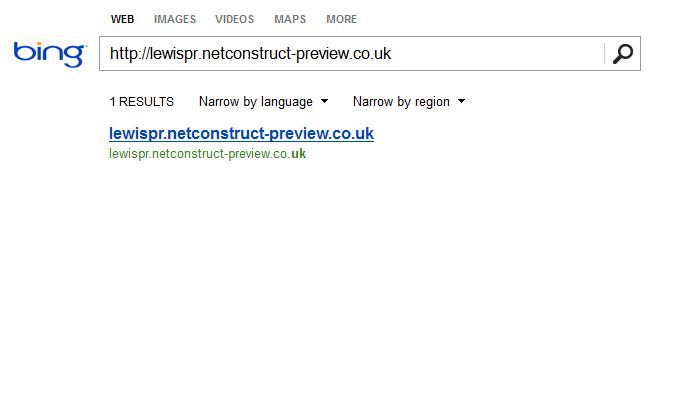
Does bing ignore robots text files or is there something missing from http://lewispr.netconstruct-preview.co.uk/robots.txt I need to add to stop bing indexing a preview site as illustrated below.
http://i216.photobucket.com/albums/cc53/zymurgy_bucket/preview-bing-indexed.jpg
Any insights welcome

-
Thanks Clever PHD - we are now adding your recommendations to our preview sites

-
I know this does not sound related, but Matt Cutts explains this same situation on Google. It is probably the same reasoning for Bing.
http://www.mattcutts.com/blog/robots-txt-remove-url/
Looking at your screen shot, it looks as if all that is being shown in Bing is just the URL, no title tag, description, no other information.
What Matt says is that they did not technically crawl the url, but they are aware that it exists. Example, there is another page linking to it with related content or the anchor tag on the link relates to the keyword search you are performing.
You are searching for the URL specifically and so it makes sense that they would show the URL as it relates to that search, but they are not showing any information from the page as they do not have it as they did not spider it, again, they are just aware of the URL. Kind of like talking to a lawyer eh?
If you search for any other keywords does this excluded site show up? Probably not. If the do, then they are probably only showing the URL like in the example above.
The video has more details. Here are the solutions he gives, I will outline them as well
-
Use the Bing URL removal tool - bing bang boom. Done.
-
(my new favorite) Let the page / site be indexed but then show an noindex nofollow meta tag on the page / site. There is a subtle but important difference in the meta tag vs the robot.txt file.  The spiders have to be able to crawl the page to be able to see what they are supposed to do with it.
http://support.google.com/webmasters/bin/answer.py?hl=en&answer=93710
"When we see the noindex meta tag on a page, Google will completely drop the page from our search results, even if other pages link to it."
The thing is, if you have a robots.txt file that says don't crawl the site, then the spider never gets to the noindex meta tag to know to delete the page from the index. It sounds a little backwards, but when the page is already in the search index, you have to let the spider crawl it to then see the noindex tag so that the search engine will know to remove it from the index.
Here is what you can do as this seems to only be an issue with Bing and just with the home page. Open up the robots.txt to allow Bing to crawl the site. Restrict the crawling to the home page only and exclude all the other pages from the crawl.
On the home page that you allow Bing to crawl, add the noindex no follow meta tag and you should be set.
All of that said.Â
 If you have a single URL listed in bing with no meta data, it may not be worth all the above effort as you are not ranking for any valuable key words, but that is your call 
It is always interesting to see how the spiders and engines think so I wanted to pass this along.
Cheers!
PS - If you have a ton of pages like this - then you just would allow Bing to crawl them all and add the noindex nofollow tag to all of them.
-
Got a burning SEO question?
Subscribe to Moz Pro to gain full access to Q&A, answer questions, and ask your own.
Browse Questions
Explore more categories
-
Moz Tools
Chat with the community about the Moz tools.
-
SEO Tactics
Discuss the SEO process with fellow marketers
-
Community
Discuss industry events, jobs, and news!
-
Digital Marketing
Chat about tactics outside of SEO
-
Research & Trends
Dive into research and trends in the search industry.
-
Support
Connect on product support and feature requests.
Related Questions
-
Robot.txt : How to block a specific file type in several subdirectories ?
Hello everyone ! I need help setting up a robot.txt. I'm trying to block all pdf files in particular directories so I'm using this command. In the example below the line is blocking all .gif in the entire site. Block files of a specific file type (for example, .gif) | Disallow: /*.gif$ 2 questions : Can I use this command to specify one particular directory in which I want to block pdf files ? Will this line be recognized by googlebots ? Disallow: /fileadmin/xxxxxxx/xxx/xxxxxxx/*.pdf$ Then I realized that I would have to write as many lines as many directories there are in which I want to block pdf files. Let's say I want to block pdf files in all these 3 directories /fileadmin/directory1 /fileadmin/directory1/sub1 /fileadmin/directory1/sub1/pdf Is there a pattern-matching rule I could use to blocks access to pdf files in all subdirectories instead of writing 3x the above line for each subdirectory ? For exemple : Disallow: /fileadmin/directory1*/ Many thanks in advance for any insight you may have.
Technical SEO | | LabeliumUSA0 -
One robots.txt file for multiple sites?
I have 2 sites hosted with Blue Host and was told to put the robots.txt in the root folder and just use the one robots.txt for both sites. Is this right? It seems wrong. I want to block certain things on one site. Thanks for the help, Rena
Technical SEO | | renalynd270 -
Robots txt. in page with 301 redirect
We currently have a a series of help pages that we would like to disallow from our robots txt. The thing is that these help pages are located in our old website, which now has a 301 redirect to current site. Which is the proper way to go around? 1- Add the pages we want to disallow to the robots.txt of the new website? 2- Break the redirect momentarily and add the pages to the robots.txt of the old one? Thanks
Technical SEO | | Kilgray0 -
Robots.txt on subdomains
Hi guys! I keep reading conflicting information on this and it's left me a little unsure. Am I right in thinking that a website with a subdomain of shop.sitetitle.com will share the same robots.txt file as the root domain?
Technical SEO | | Whittie0 -
Blocking Affiliate Links via robots.txt
Hi, I work with a client who has a large affiliate network pointing to their domain which is a large part of their inbound marketing strategy. All of these links point to a subdomain of affiliates.example.com, which then redirects the links through a 301 redirect to the relevant target page for the link. These links have been showing up in Webmaster Tools as top linking domains and also in the latest downloaded links reports. To follow guidelines and ensure that these links aren't counted by Google for either positive or negative impact on the site, we have added a block on the robots.txt of the affiliates.example.com subdomain, blocking search engines from crawling the full subddomain. The robots.txt file is the following code: User-agent: * Disallow: / We have authenticated the subdomain with Google Webmaster Tools and made certain that Google can reach and read the robots.txt file. We know they are being blocked from reading the affiliates subdomain. However, we added this affiliates subdomain block a few weeks ago to the robots.txt, but links are still showing up in the latest downloads report as first being discovered after we added the block. It's been a few weeks already, and we want to make sure that the block was implemented properly and that these links aren't being used to negatively impact the site. Any suggestions or clarification would be helpful - if the subdomain is being blocked for the search engines, why are the search engines following the links and reporting them in the www.example.com subdomain GWMT account as latest links. And if the block is implemented properly, will the total number of links pointing to our site  as reported in the links to your site section be reduced, or does this not have an impact on that figure?From a development standpoint, it's a much easier fix for us to adjust the robots.txt file than to change the affiliate linking connection from a 301 to a 302, which is why we decided to go with this option.Any help you can offer will be greatly appreciated.Thanks,Mark
Technical SEO | | Mark_Ginsberg0 -
Empty Meta Robots Directive - Harmful?
Hi, We had a coding update and a side-effect of that was that our directive was emptied, in other words it now reads as: on all of the site. I've since noticed that Google's cache date on all of the pages - at least, the ones I tested - have a Cached date of no later than 17 December '12 - that's the Monday after the directive was removed on mass. So, A, does anyone have solid evidence of an empty directive causing problems? Past experience, Matt Cutts, Fishkin quote, etc. And then B - It seems fairly well correlated but, does my entire site's homogenous Cached date point to this tag removal? Or is it fairly normal to have a particular cache date across a large site (we're a large ecommerce site). Our site: http://www.zando.co.za/ I'm having the directive reinstated as soon as Dev permitting. And then, for extra credit, is there a way with Google's API, or perhaps some other tool, to run an arbitrary list and retrieve Cached dates? I'd want to do this for diagnosis purposes and preferably in a way that OK with Google. I'd avoid CURLing for the cached URL and scraping out that dates with BASH, or any such kind of thing. Cheers,
Technical SEO | | RocketZando0 -
How can I find my Webmaster Tools HTML file?
So, totally amateur hour here, but I can't for the life of me find our HTML verification file for webmaster tools. I see nowhere to look at it in Google Webmaster Tools console, I tried a site:, I googled it, all the info out there is about how to verify a site. Ours is verified, but I need the verification file code to sync up with the Google API and no one seems to have it. Any thoughts?
Technical SEO | | healthgrades0 -
Internal search : rel=canonical vs noindex vs robots.txt
Hi everyone, I have a website with a lot of internal search results pages indexed. I'm not asking if they should be indexed or not, IÂ know they should not according to Google's guidelines. And they make a bunch of duplicated pages so I want to solve this problem. The thing is, if I noindex them, the site is gonna lose a non-negligible chunk of traffic : nearly 13% according to google analytics !!! I thought of blocking them in robots.txt. This solution would not keep them out of the index. But the pages appearing in GG SERPS would then look empty (no title, no description), thus their CTR would plummet and I would lose a bit of traffic too... The last idea I had was to use a rel=canonical tag pointing to the original search page (that is empty, without results), but it would probably have the same effect as noindexing them, wouldn't it ? (never tried so I'm not sure of this) Of course I did some research on the subject, but each of my finding recommanded one of the 3 methods only ! One even recommanded noindex+robots.txt block which is stupid because the noindex would then be useless... Is there somebody who can tell me which option is the best to keep this traffic ? Thanks a million
Technical SEO | | JohannCR0