Moz Q&A is closed.
After more than 13 years, and tens of thousands of questions, Moz Q&A closed on 12th December 2024. Whilst we’re not completely removing the content - many posts will still be possible to view - we have locked both new posts and new replies. More details here.
Unsolved Why My site pages getting video index viewport issue?
-
Hello,
I have been publishing a good number of blogs on my site Flooring Flow. Though, there's been an error of the video viewport on some of my articles.
I have tried fixing it but the error is still showing in Google Search Console.
Can anyone help me fix it out?
-
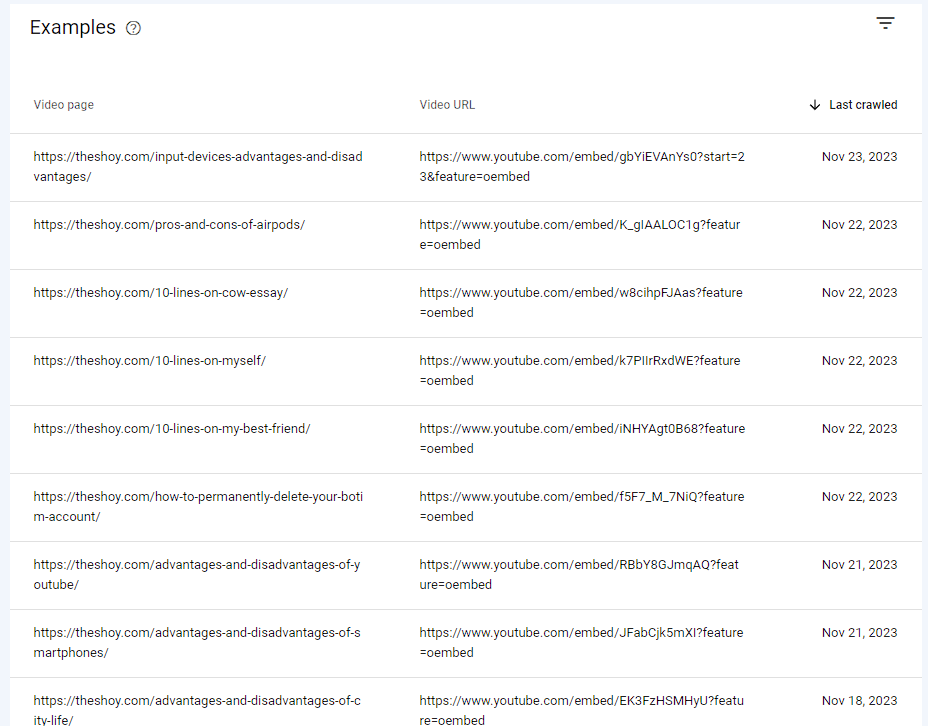
@RyanPurkey Dear Sir, My theme, and setting all is good but I am also receiving the same issue. Here are a few links that you can check, please suggest the best solution.
https://theshoy.com/advantages-and-disadvantages-of-motorcycle/
https://theshoy.com/advantages-and-disadvantages-of-smartphones/
Check the attachment below from my search console.
-
this is the link to my webstory https://stayenergies.com/web-stories/benefit-of-walking/ that getting issues with "video outside the viewport"
it is created in WordPress; is there any plugin or setting to solve it.
-
Viewport Configuration: The viewport meta tag is essential for responsive web design, as it tells the browser how to adjust the page's dimensions Ehsaas program and scale to fit different screen sizes. If the viewport is not configured correctly for video elements, search engines may have difficulty indexing and displaying videos properly.
Lazy Loading: Lazy loading is a technique used to improve page load times by deferring the loading of non-essential content, such as images and videos, until the user scrolls to that section of the page. If lazy loading is not correctly implemented for videos, it can lead to indexing issues.
Missing Video Sitemaps: Sitemaps are files that provide information about the content on your website to search engines. If you have videos on your site, it's essential to have a video sitemap that provides details about the videos, such as their titles, descriptions, and URLs. This helps search engines index your videos more effectively.
Accessibility Issues: Video content should be accessible to all users, including those with disabilities. If your videos lack proper captions, transcripts, or other accessibility features, it may lead to indexing issues.
-
If your site pages are experiencing a "video index viewport issue," it likely refers to problems related to how videos are indexed and displayed within the viewport on your website. The viewport is the visible area of a web page that a user can see without scrolling. Without further information, it's challenging to pinpoint the exact issue, but here are some common reasons and potential solutions for video index viewport problems:
Responsive Design: Ensure that your website has a responsive design, meaning it adapts and displays correctly on various screen sizes and devices. If the video container's size isn't adjusting properly to different viewports, the video may be cut off or not visible entirely.
Viewport Meta Tag: Make sure your web pages include the viewport meta tag in the <head> section. This tag helps the browser to correctly scale and render the content to fit different screen sizes.
Example viewport meta tag: <meta name="viewport" content="width=device-width, initial-scale=1">
Video Element Attributes: Check the HTML attributes of the video element. Setting the width and height attributes can help the browser allocate the correct space for the video player.Example video element:<video width="640" height="360" controls>
<source src="video.mp4" type="video/mp4">
Your browser does not support the video tag.
</video>
CSS Issues: Review your CSS styles to ensure that they don't interfere with the video's display. Sometimes, conflicting styles or positioning can lead to improper video rendering.Lazy Loading: If you are using lazy loading for videos, verify that it's implemented correctly. Lazy loading delays the loading of the video until it's about to come into the user's viewport, which might affect how it's indexed and displayed.
JavaScript Conflicts: Check if any JavaScript on your site is causing conflicts with video players or the viewport settings.
Browser Compatibility: Test your site on various browsers to ensure that the issue isn't browser-specific.
Video Format: Ensure that your videos are in a format supported by major browsers, such as MP4 with H.264 video codec and AAC audio codec.
Server Configuration: In some cases, server misconfigurations may lead to video loading issues. Ensure that your server is correctly configured to serve videos.
Testing and Debugging: Use browser developer tools to inspect the video element and check for any errors or warnings related to the video player or viewport.
Click here : Web Development company in Bangladesh -
the same issue is also occurring in my web stories when uploading any video to them. How to solve it. I have also added a video sitemap, also reduces the video size but does not solve the issue.
-
@mitty27 Your iFrame at the top of the page is hard set to 1200px width which could cause problems. Please provide some specific URLs that GSC has identified with the viewport issue for specific answers to those. Thanks and good luck!
-
Your site pages might be encountering Prestige Park Grove video index viewport issues due to improper implementation of the video index or viewport settings. It can lead to videos not displaying correctly within the visible area, affecting user experience. Check and adjust your site's code to ensure proper video indexing and viewport configuration for optimal performance.
Got a burning SEO question?
Subscribe to Moz Pro to gain full access to Q&A, answer questions, and ask your own.
Browse Questions
Explore more categories
-
Moz Tools
Chat with the community about the Moz tools.
-
SEO Tactics
Discuss the SEO process with fellow marketers
-
Community
Discuss industry events, jobs, and news!
-
Digital Marketing
Chat about tactics outside of SEO
-
Research & Trends
Dive into research and trends in the search industry.
-
Support
Connect on product support and feature requests.
Related Questions
-
Best redirect destination for 18k highly-linked pages
Technical SEO question regarding redirects; I appreciate any insights on best way to handle. Situation: We're decommissioning several major content sections on a website, comprising ~18k webpages. This is a well established site (10+ years) and many of the pages within these sections have high-quality inbound links from .orgs and .edus. Challenge: We're trying to determine the best place to redirect these 18k pages. For user experience, we believe best option is the homepage, which has a statement about the changes to the site and links to the most important remaining sections of the site. It's also the most important page on site, so the bolster of 301 redirected links doesn't seem bad. However, someone on our team is concerned that that many new redirected pages and links going to our homepage will trigger a negative SEO flag for the homepage, and recommends instead that they all go to our custom 404 page (which also includes links to important remaining sections). What's the right approach here to preserve remaining SEO value of these soon-to-be-redirected pages without triggering Google penalties?
Technical SEO | | davidvogel1 -
Unsolved Capturing Source Dynamically for UTM Parameters
Does anyone have a tutorial on how to dynamically capture the referring source to be populated in UTM parameters for Google Analytics? We want to syndicate content and be able to see all of the websites that provided referral traffic for this specific objective. We want to set a specific utm_medium and utm_campaign but have the utm_source be dynamic and capture the referring website. If we set a permanent utm_source, it would appear the same for all incoming traffic. Thanks in advance!
Technical SEO | | peteboyd0 -
Unsolved Duplicate LocalBusiness Schema Markup
Hello! I've been having a hard time finding an answer to this specific question so I figured I'd drop it here. I always add custom LocalBusiness markup to clients' homepages, but sometimes the client's website provider will include their own automated LocalBusiness markup. The codes I create often include more information. Assuming the website provider is unwilling to remove their markup, is it a bad idea to include my code as well? It seems like it could potentially be read as spammy by Google. Do the pros of having more detailed markup outweigh that potential negative impact?
Local Website Optimization | | GoogleAlgoServant0 -
Does anyone know the linking of hashtags on Wix sites does it negatively or postively impact SEO. It is coming up as an error in site crawls 'Pages with 404 errors' Anyone got any experience please?
Does anyone know the linking of hashtags on Wix sites does it negatively or positively impact SEO. It is coming up as an error in site crawls 'Pages with 404 errors' Anyone got any experience please? For example at the bottom of this blog post https://www.poppyandperle.com/post/face-painting-a-global-language the hashtags are linked, but they don't go to a page, they go to search results of all other blogs using that hashtag. Seems a bit of a strange approach to me.
Technical SEO | | Mediaholix0 -
Do URLs with canonical tags get indexed by Google?
Hi, we re-branded and launched a new website in February 2016. In June we saw a steep drop in the number of URLs indexed, and there have continued to be smaller dips since. We started an account with Moz and found several thousand high priority crawl errors for duplicate pages and have since fixed those with canonical tags. However, we are still seeing the number of URLs indexed drop. Do URLs with canonical tags get indexed by Google? I can't seem to find a definitive answer on this. A good portion of our URLs have canonical tags because they are just events with different dates, but otherwise the content of the page is the same.
Technical SEO | | zasite0 -
How can I get a photo album indexed by Google?
We have a lot of photos on our website. Unfortunately most of them don't seem to be indexed by Google. We run a party website. One of the things we do, is take pictures at events and put them on the site. An event page with a photo album, can have anywhere between 100 and 750 photo's. For each foto's there is a thumbnail on the page. The thumbnails are lazy loaded by showing a placeholder and loading the picture right before it comes onscreen. There is no pagination of infinite scrolling. Thumbnails don't have an alt text. Each thumbnail links to a picture page. This page only shows the base HTML structure (menu, etc), the image and a close button. The image has a src attribute with full size image, a srcset with several sizes for responsive design and an alt text. There is no real textual content on an image page. (Note that when a user clicks on the thumbnail, the large image is loaded using JavaScript and we mimic the page change. I think it doesn't matter, but am unsure.) I'd like that full size images should be indexed by Google and found with Google image search. Thumbnails should not be indexed (or ignored). Unfortunately most pictures aren't found or their thumbnail is shown. Moz is giving telling me that all the picture pages are duplicate content (19,521 issues), as they are all the same with the exception of the image. The page title isn't the same but similar for all images of an album. Example: On the "A day at the park" event page, we have 136 pictures. A site search on "a day at the park" foto, only reveals two photo's of the albums. 3QolbbI.png QTQVxqY.jpg mwEG90S.jpg
Technical SEO | | jasny0 -
Do YouTube videos in iFrames get crawled?
There seems to be quite a few articles out there that say iframes cause problems with organic search and that the various bots can't/won't crawl them. Most of the articles are a few years old (including Moz's video sitemap article). I'm wondering if this is still the case with YouTube/Vimeo/etc videos, all of which only offer iFrames as an embed option. I have a hard time believing that a Google property (YT) would offer an embed option that it's own bot couldn't crawl. However, let me know if that is in fact the case. Thanks! Jim
Technical SEO | | DigitalAnarchy0 -
Removed Subdomain Sites Still in Google Index
Hey guys, I've got kind of a strange situation going on and I can't seem to find it addressed anywhere. I have a site that at one point had several development sites set up at subdomains. Those sites have since launched on their own domains, but the subdomain sites are still showing up in the Google index. However, if you look at the cached version of pages on these non-existent subdomains, it lists the NEW url, not the dev one in the little blurb that says "This is Google's cached version of www.correcturl.com." Clearly Google recognizes that the content resides at the new location, so how come the old pages are still in the index? Attempting to visit one of them gives a "Server Not Found" error, so they are definitely gone. This is happening to a couple of sites, one that was launched over a year ago so it doesn't appear to be a "wait and see" solution. Any suggestions would be a huge help. Thanks!!
Technical SEO | | SarahLK0