Moz Q&A is closed.
After more than 13 years, and tens of thousands of questions, Moz Q&A closed on 12th December 2024. Whilst we’re not completely removing the content - many posts will still be possible to view - we have locked both new posts and new replies. More details here.
Page Indexing without content
-
Hello.
I have a problem of page indexing without content. I have website in 3 different languages and 2 of the pages are indexing just fine, but one language page (the most important one) is indexing without content. When searching using site: page comes up, but when searching unique keywords for which I should rank 100% nothing comes up.
This page was indexing just fine and the problem arose couple of days ago after google update finished. Looking further, the problem is language related and every page in the given language that is newly indexed has this problem, while pages that were last crawled around one week ago are just fine.
Has anyone ran into this type of problem?
-
I've encountered a similar indexing issue on my website, https://sunasusa.com/. To resolve it, ensure that the language markup and content accessibility on the affected pages are correct. Review any recent changes and the quality of your content. Utilize Google Search Console for insights, or consider reaching out to Google support for assistance.
-
To remove hacked URLs in bulk from Google's index, clean up your website, secure it, and then use Google Search Console to request removal of the unwanted URLs. Additionally, submit a new sitemap containing only valid URLs to expedite re-indexing.
-
It seems that after a recent Google update, one language version of your website is experiencing indexing issues, while others remain unaffected. This could be due to factors like changes in algorithms or technical issues. To address this:
- Check h reflag tags and content quality.
- Review technical aspects like crawlability and indexing directives. Deck Services in Duluth GA
- Monitor Google Search Console for errors.
- Consider seeking expert assistance if needed.
-
@AtuliSulava Re: Website blog is hacked. Whats the best practice to remove bad urls
something similar problem also happened to me. many urls are indexed but they have no content in actual. My website(scaleme) was hacked and thousands of URLs with Japanese content were added to my site. These URLs are now indexed by Google. How can I remove them in bulk? (ScreenShoot attached)
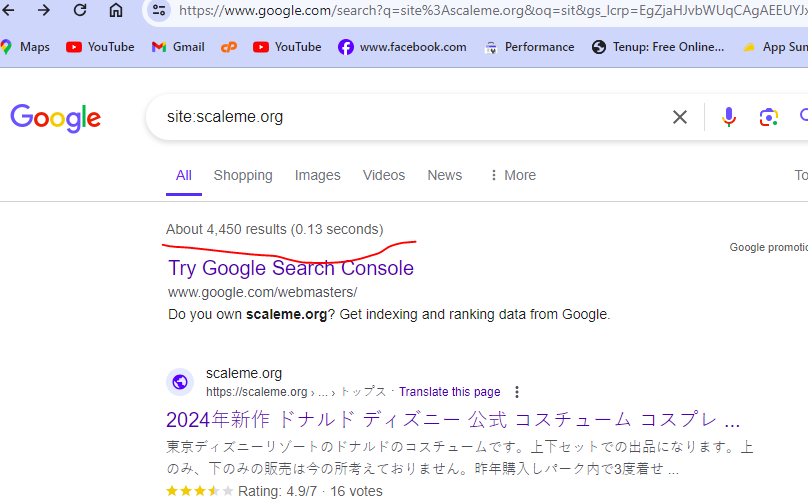
I am the owner of this website. thousands of Japanese-language URLs (more than 4400) were added to my site. i am aware with google url remover tool but adding one by one url and submitting for removing is not possible because there are large number of url indexed by google.
Is there a way to find these url , downlaod a list and remove these URLs in bulk? is Moz have any tool to solve this problem?
-
I've faced a similar indexing issue on my website https://mobilespackages.in/ myself. To resolve it, ensure correct language markup and content accessibility on the affected pages. Review recent changes and content quality. Utilize Google Search Console for insights or reach out to Google support.
-
@AtuliSulava It sounds like you're experiencing a frustrating issue with your website's indexing. I have faced this issue. Unfortunately, I have prevented my website from indexing in google by mistake. Here are some steps you can take to troubleshoot and potentially resolve the problem:
Check Robots.txt: Ensure that your site's robots.txt file is not blocking search engine bots from accessing the content on the affected pages.
Review Meta Tags: Check the <meta name="robots" content="noindex"> tag on the affected pages. If present, remove it to allow indexing.
Content Accessibility: Make sure that the content on the affected pages is accessible to search engine bots. Check for any JavaScript, CSS, or other elements that might be blocking access to the content.
Canonical Tags: Verify that the canonical tags on the affected pages are correctly pointing to the preferred version of the page.
Structured Data Markup: Ensure that your pages have correct structured data markup to help search engines understand the content better.
Fetch as Google: Use Google Search Console's "Fetch as Google" tool to see how Googlebot sees your page and if there are any issues with rendering or accessing the content.
Monitor Google Search Console: Keep an eye on Google Search Console for any messages or issues related to indexing and crawlability of your site.
Wait for Re-crawl: Sometimes, Google's indexing issues resolve themselves over time as the search engine re-crawls and re-indexes your site. If the problem persists, consider requesting a re-crawl through Google Search Console.
If the issue continues, it might be beneficial to seek help from a professional SEO consultant who can perform a detailed analysis of your website and provide specific recommendations tailored to your situation. -
@AtuliSulava Perhaps indexing of blank pages is prohibited on this site, look for more information on how to check the ban on indexing in which site files...
Got a burning SEO question?
Subscribe to Moz Pro to gain full access to Q&A, answer questions, and ask your own.
Browse Questions
Explore more categories
-
Moz Tools
Chat with the community about the Moz tools.
-
SEO Tactics
Discuss the SEO process with fellow marketers
-
Community
Discuss industry events, jobs, and news!
-
Digital Marketing
Chat about tactics outside of SEO
-
Research & Trends
Dive into research and trends in the search industry.
-
Support
Connect on product support and feature requests.
Related Questions
-
Google keeps marking different pages as duplicates
My website has many pages like this: mywebsite/company1/valuation mywebsite/company2/valuation mywebsite/company3/valuation mywebsite/company4/valuation ... These pages describe the valuation of each company. These pages were never identical but initially, I included a few generic paragraphs like what is valuation, what is a valuation model, etc... in all the pages so some parts of these pages' content were identical. Google marked many of these pages as duplicated (in Google Search Console) so I modified the content of these pages: I removed those generic paragraphs and added other information that is unique to each company. As a result, these pages are extremely different from each other now and have little similarities. Although it has been more than 1 month since I made the modification, Google still marks the majority of these pages as duplicates, even though Google has already crawled their new modified version. I wonder whether there is anything else I can do in this situation? Thanks
Technical SEO | | TuanDo96270 -
Unsolved Why My site pages getting video index viewport issue?
Hello, I have been publishing a good number of blogs on my site Flooring Flow. Though, there's been an error of the video viewport on some of my articles. I have tried fixing it but the error is still showing in Google Search Console. Can anyone help me fix it out?
Technical SEO | | mitty270 -
Best SEO Structure For E-Commerce With Products Using Multiple Categories
Hi all, I am in the process of re-structuring my e-commerce website for better SEO and user experience. I have done some keyword research and would like some advice on how best to structure my site around those keywords. For example, my site (All Things Nature) sells a brand of wooden sculptures (Woodsculp) and I would like to rank for keywords related to that brand, the brand by animal, the brand by collection and the brand by release date.
Content Development | | nb2e4fg
Examples of keywords could be: Brand by Animal: Woodsculp Dogs, Woodsculp Cats, Woodsculp Elephants
Brand by Collection: Woodsculp Pets, Woodsculp Safari
Brand by Release Date: Woodsculp Christmas 2023, Woodsculp Summer 2022 I would create each of these keywords as a category so that they can be found by a search engine and by users. I would then structure as follows: All Things Nature -> Woodsculp -> Woodsculp by Animal -> Woodsculp Dogs
All Things Nature -> Woodsculp -> Woodsculp by Animal -> Woodsculp Elephants
All Things Nature -> Woodsculp -> Woodsculp by Collection -> Woodsculp Pets
All Things Nature -> Woodsculp -> Woodsculp by Collection -> Woodsculp Safari
All Things Nature -> Woodsculp -> Woodsculp by Release Date -> Woodsculp Christmas 2023
All Things Nature -> Woodsculp -> Woodsculp by Release Date -> Woodsculp Summer 2022 The only problem with this structure is it would take more than 3 clicks (4) for the user to reach a product. How critical is this for good SEO and user experience? Would I be better off getting rid of the ‘Woodsculp by Animal’, ‘Woodsculp by Collection’ and ‘Woodsculp by Release Date’ categories? Structure would look as follows: All Things Nature -> Woodsculp -> Woodsculp Dogs
All Things Nature -> Woodsculp -> Woodsculp Elephants
All Things Nature -> Woodsculp -> Woodsculp Safari
All Things Nature -> Woodsculp -> Woodsculp Christmas 2023 The only thing with this is there would be a lot of categories under the brand name which might make it more difficult for search engines and users to logically follow. Would I be better off getting rid of the brand category and replace them with the keyword categories? Structure would look as follows: All Things Nature -> Woodsculp by Animal -> Woodsculp Dogs
All Things Nature -> Woodsculp by Animal -> Woodsculp Elephants
All Things Nature -> Woodsculp by Collection -> Woodsculp Safari
All Things Nature -> Woodsculp by Release Date -> Woodsculp Christmas 2023 This would organise things more logically but I would then lose the brand category (and the potential of the brand keyword ranking?) Would I be better off choosing one main keyword to use as a category and then use tags for the other categories? Categories: All Things Nature -> Woodsculp -> Woodsculp Dogs
All Things Nature -> Woodsculp -> Woodsculp Elephants Tags: Woodsculp Safari
Woodsculp Christmas 2023 The next issue I have is that I have products which could fall under several different categories. A product called Elijah Elephant, for example could fall under Woodsculp Elephants, Woodsculp Safari and Woodsculp Summer 2022. In previous e-commerce sites I have never assigned multiple categories to one product (I instead have used tags). Is it good practice to organise products under multiple categories for an e-commerce site? Thanks in advance for any help and advice.0 -
Is page speed important to improve SEO ranking?
I saw on a SEO Agency's site (https://burstdgtl.com/search-engine-optimization/) that page speed apparently affects Google ranking. Is this true? And if it is, how do I improve it, do I need an agency?
On-Page Optimization | | jasparcj0 -
Collections or blog posts for Shopify ecommerce seo?
Hi, hope you guys can help as I am going down a rabbit hole with this one! We have a solid-ranking sports nutrition site and are building a new SEO keyword strategy on our Shopify built store. We are using collections (categories) for much of the key product-based seo. This is because, as we understand it, Google prioritises collection/category pages over product pages. Should we then build additional collection pages to rank for secondary product search terms that could fit a collection page structure (eg 'vegan sports nutrition'), or should we use blog posts to do this? We have a quality blog with good unique content and reasonable domain authority so both options are open to us. But while the collection/category option may be best for SEO, too many collections/categories could upset our UX. We have a very small product range (10 products) so want to keep navigation fast and easy. Our 7 lead keyword collection pages do this already. More run the risk of upsetting ease/speed of site navigation. On the other hand, conversion rate from collection pages is historically much better than blog pages. We have made major technical upgrades to the blog to improve this but these are yet to be tested in anger. So at the heart of it all - do you guys recommend favouring blog posts or collection/category pages for secondary high sales intent keywords? All help gratefully received - thanks!
SEO Tactics | | WP332 -
Unnecessary pages getting indexed in Google for my blog
I have a blog dapazze.com and I am suffering from a problem for a long time. I found out that Google have indexed hundreds of replytocom links and images attachment pages for my blog. I had to remove these pages manually using the URL removal tool. I had used "Disallow: ?replytocom" in my robots.txt, but Google disobeyed it. After that, I removed the parameter from my blog completely using the SEO by Yoast plugin. But now I see that Google has again started indexing these links even after they are not present in my blog (I use #comment). Google have also indexed many of my admin and plugin pages, whereas they are disallowed in my robots.txt file. Have a look at my robots.txt file here: http://dapazze.com/robots.txt Please help me out to solve this problem permanently?
Technical SEO | | rahulchowdhury0 -
De-indexing millions of pages - would this work?
Hi all, We run an e-commerce site with a catalogue of around 5 million products. Unfortunately, we have let Googlebot crawl and index tens of millions of search URLs, the majority of which are very thin of content or duplicates of other URLs. In short: we are in deep. Our bloated Google-index is hampering our real content to rank; Googlebot does not bother crawling our real content (product pages specifically) and hammers the life out of our servers. Since having Googlebot crawl and de-index tens of millions of old URLs would probably take years (?), my plan is this: 301 redirect all old SERP URLs to a new SERP URL. If new URL should not be indexed, add meta robots noindex tag on new URL. When it is evident that Google has indexed most "high quality" new URLs, robots.txt disallow crawling of old SERP URLs. Then directory style remove all old SERP URLs in GWT URL Removal Tool This would be an example of an old URL:
Technical SEO | | TalkInThePark
www.site.com/cgi-bin/weirdapplicationname.cgi?word=bmw&what=1.2&how=2 This would be an example of a new URL:
www.site.com/search?q=bmw&category=cars&color=blue I have to specific questions: Would Google both de-index the old URL and not index the new URL after 301 redirecting the old URL to the new URL (which is noindexed) as described in point 2 above? What risks are associated with removing tens of millions of URLs directory style in GWT URL Removal Tool? I have done this before but then I removed "only" some useless 50 000 "add to cart"-URLs.Google says themselves that you should not remove duplicate/thin content this way and that using this tool tools this way "may cause problems for your site". And yes, these tens of millions of SERP URLs is a result of a faceted navigation/search function let loose all to long.
And no, we cannot wait for Googlebot to crawl all these millions of URLs in order to discover the 301. By then we would be out of business. Best regards,
TalkInThePark0