Moz Q&A is closed.
After more than 13 years, and tens of thousands of questions, Moz Q&A closed on 12th December 2024. Whilst we’re not completely removing the content - many posts will still be possible to view - we have locked both new posts and new replies. More details here.
Keywords are indexed on the home page
-
Hello everyone,
For one of our websites, we have optimized for many keywords. However, it seems that every keyword is indexed on the home page, and thus not ranked properly. This occurs only on one of our many websites. I am wondering if anyone knows the cause of this issue, and how to solve it.
Thank you.
-
No, I wouldn't say that would cause such issues.
Your pages should get indexed eventually, as they are in your sitemaps (at least the ones I checked), so I am not surprised you're not seeing issues in reports.
But, tools like Moz will often struggle to give more strategic advice (not that we aren't working on it!), and in this case, if these pages are a priority, you need to prominently link to them within your site - this is the most reliably way to ensure rapid indexing.
-
@tom-capper Hey Tom, thanks a lot for all your support so far.
What I have noticed in other campaigns too, is that our websites have CLS (cumulative layout shift) problems. This is the only issue that I found in the account for Brekken. Do you know by any chance if this is something that causes pages to not get indexed correctly?
Thanks!
-
@ginovdw said in Keywords are indexed on the home page:
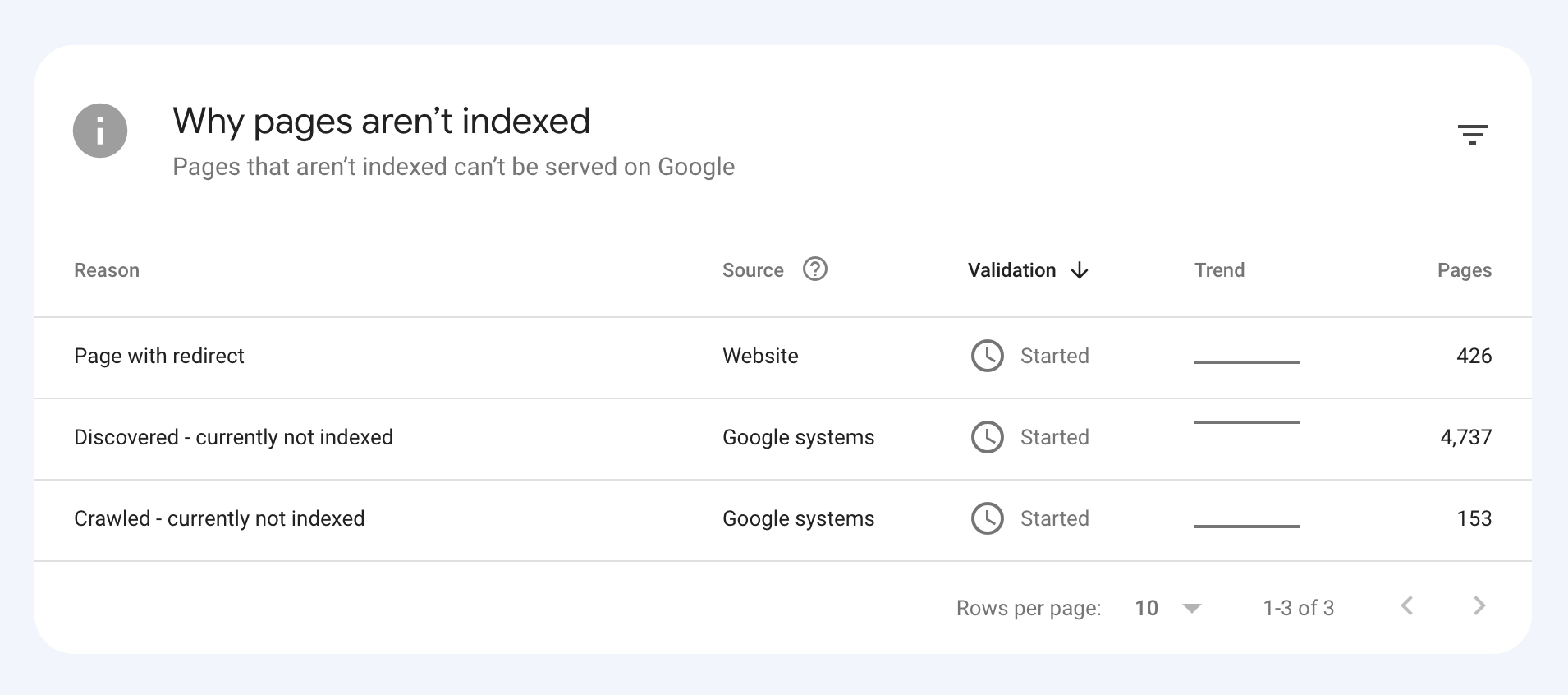
It seems like some of those simply aren't indexed.
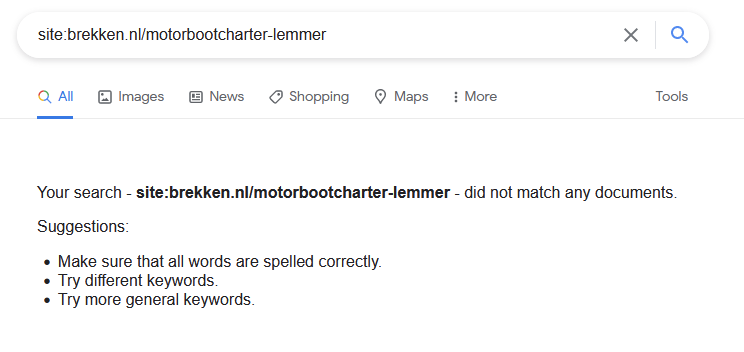
As above, I recommend you investigate in Google Search Console for a clearer idea of why it isn't indexed, but I notice with /motorbootcharter-lemmer it is listed in your sitemaps, so probably Google will index it eventually.
If you want Google to better understand the value of these pages, consider including them in your main navigation, or linking from the homepage.
-
@ginovdw Have you been able to confirm that those other pages are crawled, indexed, and correctly rendered by Google?
For example, what happens if you inspect them in Google Search Console?
-
So, an example of one of our websites is below:
We optimized the following keywords on the following pages:
Motorbootcharter Lemmer: https://brekken.nl/motorbootcharter-lemmer
Jachtverhuur Lemmer:
https://brekken.nl/jachtverhuur-lemmerBootverhuur IJsselmeer:
https://brekken.nl/bootverhuur-ijsselmeerBoot verhuur in Friesland
https://brekken.nl/boot-verhuur-in-frieslandBoot huren IJsselmeer
https://brekken.nl/boot-huren-ijsselmeerYet, they all rank on the home page of our website. Some of these words are not even mentioned on our home page, or just once. I just don't see why they don't rank on their respective keyword which we optimized for, since this works for many of our other websites.
-
@ginovdw En effet, donnez plus d'informations, sinon ce n'est pas tout à fait clair avec quoi vous comparez et avec quoi voulez-vous vous classer ?
-
@tom-capper Thanks for your response! It's exactly what you mentioned. We have many pages optimized for those terms, but they all rank on our homepage.
-
@ginovdw Heya
Could you explain a little more what you're running in to?
For example, when you say that keywords are indexed on the homepage, do you mean that your homepage is ranking for all terms, even though you have optimized other pages for those terms?
Got a burning SEO question?
Subscribe to Moz Pro to gain full access to Q&A, answer questions, and ask your own.
Browse Questions
Explore more categories
-
Moz Tools
Chat with the community about the Moz tools.
-
SEO Tactics
Discuss the SEO process with fellow marketers
-
Community
Discuss industry events, jobs, and news!
-
Digital Marketing
Chat about tactics outside of SEO
-
Research & Trends
Dive into research and trends in the search industry.
-
Support
Connect on product support and feature requests.
Related Questions
-
Unsolved Wild fluctuations in ranking, any thoughts on why or what to do about it?
We have a keyword which is important to us and used to have rock steady rankings for over a decade. Over the past 9 months or so it has been fluctuating all over the place. Jumping up or down 20 places or so overnight. Any thoughts on this behaviour and what we should be doing to stabilise the ranking?Screenshot 2024-05-13 at 09.47.jpg
Reporting & Analytics | | Hannahm240 -
How to index e-commerce marketplace product pages
Hello! We are an online marketplace that submitted our sitemap through Google Search Console 2 weeks ago. Although the sitemap has been submitted successfully, out of ~10000 links (we have ~10000 product pages), we only have 25 that have been indexed. I've attached images of the reasons given for not indexing the platform. gsc-dashboard-1 gsc-dashboard-2 How would we go about fixing this?
Technical SEO | | fbcosta0 -
Dynamic Canonical Tag for Search Results Filtering Page
Hi everyone, I run a website in the travel industry where most users land on a location page (e.g. domain.com/product/location, before performing a search by selecting dates and times. This then takes them to a pre filtered dynamic search results page with options for their selected location on a separate URL (e.g. /book/results). The /book/results page can only be accessed on our website by performing a search, and URL's with search parameters from this page have never been indexed in the past. We work with some large partners who use our booking engine who have recently started linking to these pre filtered search results pages. This is not being done on a large scale and at present we only have a couple of hundred of these search results pages indexed. I could easily add a noindex or self-referencing canonical tag to the /book/results page to remove them, however it’s been suggested that adding a dynamic canonical tag to our pre filtered results pages pointing to the location page (based on the location information in the query string) could be beneficial for the SEO of our location pages. This makes sense as the partner websites that link to our /book/results page are very high authority and any way that this could be passed to our location pages (which are our most important in terms of rankings) sounds good, however I have a couple of concerns. • Is using a dynamic canonical tag in this way considered spammy / manipulative? • Whilst all the content that appears on the pre filtered /book/results page is present on the static location page where the search initiates and which the canonical tag would point to, it is presented differently and there is a lot more content on the static location page that isn’t present on the /book/results page. Is this likely to see the canonical tag being ignored / link equity not being passed as hoped, and are there greater risks to this that I should be worried about? I can’t find many examples of other sites where this has been implemented but the closest would probably be booking.com. https://www.booking.com/searchresults.it.html?label=gen173nr-1FCAEoggI46AdIM1gEaFCIAQGYARS4ARfIAQzYAQHoAQH4AQuIAgGoAgO4ArajrpcGwAIB0gIkYmUxYjNlZWMtYWQzMi00NWJmLTk5NTItNzY1MzljZTVhOTk02AIG4AIB&sid=d4030ebf4f04bb7ddcb2b04d1bade521&dest_id=-2601889&dest_type=city& Canonical points to https://www.booking.com/city/gb/london.it.html In our scenario however there is a greater difference between the content on both pages (and booking.com have a load of search results pages indexed which is not what we’re looking for) Would be great to get any feedback on this before I rule it out. Thanks!
Technical SEO | | GAnalytics1 -
Google Not Indexing Pages (Wordpress)
Hello, recently I started noticing that google is not indexing our new pages or our new blog posts. We are simply getting a "Discovered - Currently Not Indexed" message on all new pages. When I click "Request Indexing" is takes a few days, but eventually it does get indexed and is on Google. This is very strange, as our website has been around since the late 90's and the quality of the new content is neither duplicate nor "low quality". We started noticing this happening around February. We also do not have many pages - maybe 500 maximum? I have looked at all the obvious answers (allowing for indexing, etc.), but just can't seem to pinpoint a reason why. Has anyone had this happen recently? It is getting very annoying having to manually go in and request indexing for every page and makes me think there may be some underlying issues with the website that should be fixed.
Technical SEO | | Hasanovic1 -
Japanese URL-structured sitemap (pages) not being indexed by Bing Webmaster Tools
Hello everyone, I am facing an issue with the sitemap submission feature in Bing Webmaster Tools for a Japanese language subdirectory domain project. Just to outline the key points: The website is based on a subdirectory URL ( example.com/ja/ ) The Japanese URLs (when pages are published in WordPress) are not being encoded. They are entered in pure Kanji. Google Webmaster Tools, for instance, has no issues reading and indexing the page's URLs in its sitemap submission area (all pages are being indexed). When it comes to Bing Webmaster Tools it's a different story, though. Basically, after the sitemap has been submitted ( example.com/ja/sitemap.xml ), it does report an error that it failed to download this part of the sitemap: "page-sitemap.xml" (basically the sitemap featuring all the sites pages). That means that no URLs have been submitted to Bing either. My apprehension is that Bing Webmaster Tools does not understand the Japanese URLs (or the Kanji for that matter). Therefore, I generally wonder what the correct way is to go on about this. When viewing the sitemap ( example.com/ja/page-sitemap.xml ) in a web browser, though, the Japanese URL's characters are already displayed as encoded. I am not sure if submitting the Kanji style URLs separately is a solution. In Bing Webmaster Tools this can only be done on the root domain level ( example.com ). However, surely there must be a way to make Bing's sitemap submission understand Japanese style sitemaps? Many thanks everyone for any advice!
Technical SEO | | Hermski0 -
Does Google index internal anchors as separate pages?
Hi, Back in September, I added a function that sets an anchor on each subheading (h[2-6]) and creates a Table of content that links to each of those anchors. These anchors did show up in the SERPs as JumpTo Links. Fine. Back then I also changed the canonicals to a slightly different structur and meanwhile there was some massive increase in the number of indexed pages - WAY over the top - which has since been fixed by removing (410) a complete section of the site. However ... there are still ~34.000 pages indexed to what really are more like 4.000 plus (all properly canonicalised). Naturally I am wondering, what google thinks it is indexing. The number is just way of and quite inexplainable. So I was wondering: Does Google save JumpTo links as unique pages? Also, does anybody know any method of actually getting all the pages in the google index? (Not actually existing sites via Screaming Frog etc, but actual pages in the index - all methods I found sadly do not work.) Finally: Does somebody have any other explanation for the incongruency in indexed vs. actual pages? Thanks for your replies! Nico
Technical SEO | | netzkern_AG0 -
Best way to handle pages with iframes that I don't want indexed? Noindex in the header?
I am doing a bit of SEO work for a friend, and the situation is the following: The site is a place to discuss articles on the web. When clicking on a link that has been posted, it sends the user to a URL on the main site that is URL.com/article/view. This page has a large iframe that contains the article itself, and a small bar at the top containing the article with various links to get back to the original site. I'd like to make sure that the comment pages (URL.com/article) are indexed instead of all of the URL.com/article/view pages, which won't really do much for SEO. However, all of these pages are indexed. What would be the best approach to make sure the iframe pages aren't indexed? My intuition is to just have a "noindex" in the header of those pages, and just make sure that the conversation pages themselves are properly linked throughout the site, so that they get indexed properly. Does this seem right? Thanks for the help...
Technical SEO | | jim_shook0 -
Home Page .index.htm and .com Duplicate Page Content/Title
I have been whittling away at the duplicate content on my clients' sites, thanks to SEOmoz's pro report, and have been getting push back from the account manager at register.com (the site was built here and the owner doesn't want to move it). He says these are the exact same page and he can't access one to redirect to the other. Any suggestions? The SEOmoz report says there is duplicate content on both these urls: Durango Mountain Biking | Durango Mountain Resort - Cascade Village http://www.cascadevillagehotel.com/index.htm Durango Mountain Biking | Durango Mountain Resort - Cascade Village http://www.cascadevillagehotel.com/ Your help is greatly appreciated! Sheryl
Technical SEO | | TOMMarketingLtd.0