Moz Q&A is closed.
After more than 13 years, and tens of thousands of questions, Moz Q&A closed on 12th December 2024. Whilst we’re not completely removing the content - many posts will still be possible to view - we have locked both new posts and new replies. More details here.
Will skipping <H> tags affect your SEO?
-
Will skipping <H> tags on a page have any impact on your SEO, e.g. skipping a <H2> so your page has a <H1> and then goes to a <H3>?
Obviously a page must have a <H1>, but does it matter if you skip other headings?
-
I recommend you read this content about title tags. English Content - Türkçe SEO'da başlık etiketleri I hope you benefit from it.
-
In general, well-arranged <H> tags suggest that Google bots will better understand the subject of the page, but quite often I come across websites with missing tags on the first page.
-
It is a content issue. I have worked a lot with H2 and H3 headlines and see many SERP results with sitelinks with Headlines keywords. If you optimize a content with different parts and work with tables of contents, Google can recognize the structure understand your content and evaluate it. Some parts will be shown in the featured snippets as well or in FAQs. To say that they don't have any impact is wrong.
-
I think skipping <H> tags won't affect the ranking factor in SEO.
-
This depends on page structure and if you have any additional schema such as FAQs etc.
Additional keywords within your H2/3/4 tags can be extremely useful but again it depends on keywords you are targeting and how natural these headings actually are.
It's also worth thinking about the other purposes of H tags.
Even though they may or may not have an affect on SEO - H tags help with accessibility software such as screen readers to make sense of your content.
-
Thank you @Tom-Capper and @pau4ner, this is really helpful. I guess it used to have an impact on SEO but things have changed and they're no longer as important as they were.
-
In my experience and opinion, it won't have any impact at all. I've ranked pages with one H1, a bunch of H3 and no H2. Headlines are useful to organize content for users, they don't really have direct SEO purposes (although they can affect it indirectly, as a better organized content will improve user satisfaction).
Although not a headline, something I would never skip is <title> tag (even though Google can create one/rewrite the existing one).
-
From an SEO perspective, I doubt you'd see any material impact.
Even skipping the <H1> isn't awful as long as the document's overall structure and hierarchy remains clear. See this experiment we ran a while back - https://moz.com/blog/h1-seo-experiment
Got a burning SEO question?
Subscribe to Moz Pro to gain full access to Q&A, answer questions, and ask your own.
Browse Questions
Explore more categories
-
Moz Tools
Chat with the community about the Moz tools.
-
SEO Tactics
Discuss the SEO process with fellow marketers
-
Community
Discuss industry events, jobs, and news!
-
Digital Marketing
Chat about tactics outside of SEO
-
Research & Trends
Dive into research and trends in the search industry.
-
Support
Connect on product support and feature requests.
Related Questions
-
I want to move some pages of my website to a folder and nav menu in those pages should only show inner page links, will it hurt SEO?
Hi, My website has a few SaaS products, to make my website simple i want to move my website some pages to its specific folder structure , so eg website.com/product1/features
Technical SEO | | webbeemoz
website.com/product1/pricing
website.com/product1/information and same for product2 and so on, the website.com/product1/.. menu will only show the links of product1 and only one link to homepage (possibly in footer). Please share your opinion will it be a good idea, from UI perspective it will be simple , but i am not sure about SEO perspective, please help thanks1 -
Strange Traffic Movements
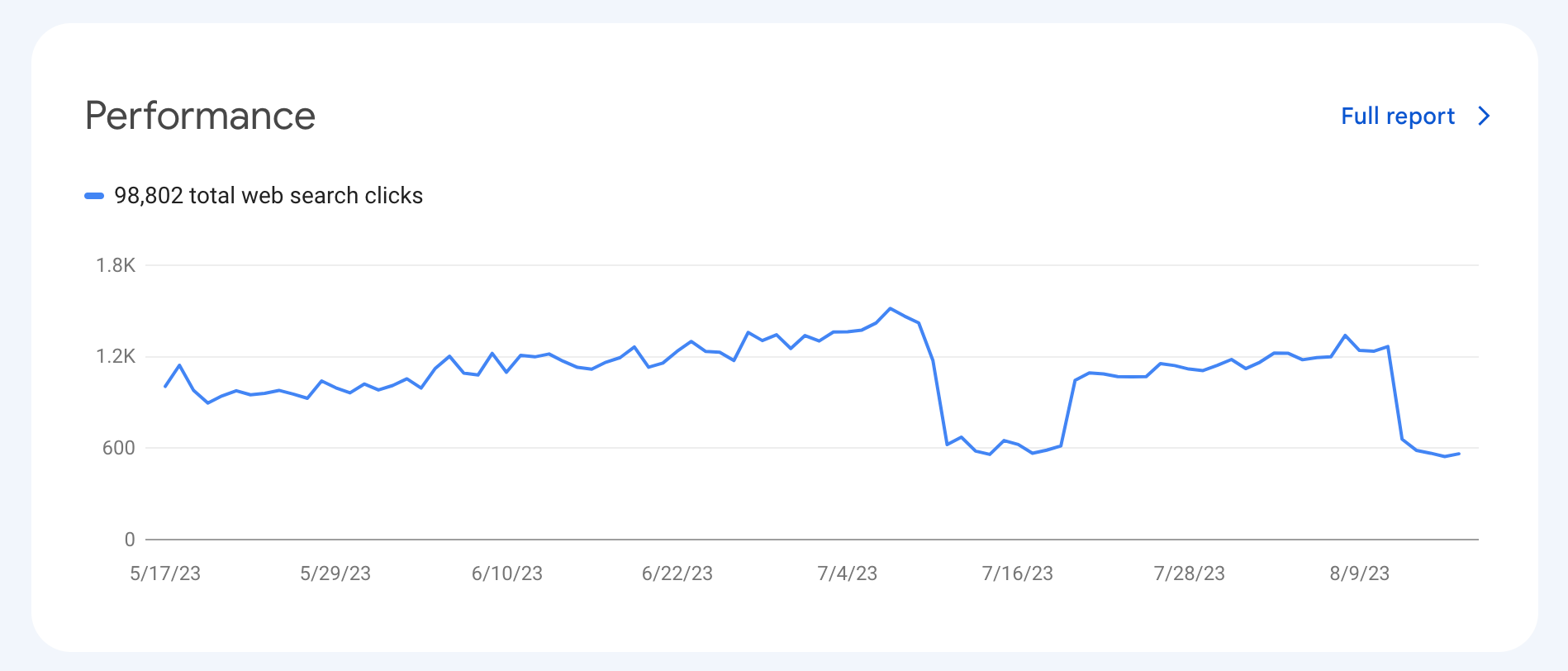
Hi there, I'm wondering if anyone can shed some light on this... I'm working with a client whose website is experiencing some odd organic traffic patterns. See screenshot attached. As you can see, there was a sudden cliff fall about a month ago, and then it recovered (almost) entirely. Then, a month to the day later, the same thing happened again. What is the likelihood that this is a data glitch vs an algorithm thing? Any light you can shed on this would be appreciated. Thanks,
Search Behavior | | mhenshall
Marc
Screenshot 2023-08-18 at 09.37.26.png image url)0 -
Appending a code at the end of a URL
Hi All, Some real estate/ news companies have a code appended to the end of a URL https://www.realestate.com.au/property-house-qld-ormiston-141747584 https://www.brisbanetimes.com.au/national/queensland/childcare-centre-could-face-prosecution-for-leaving-child-on-hot-bus-20230320-p5ctqs.html Can I ask if there's any negative SEO implications for doing this? Cheers Dave
Technical SEO | | Redooo0 -
Best SEO Structure For E-Commerce With Products Using Multiple Categories
Hi all, I am in the process of re-structuring my e-commerce website for better SEO and user experience. I have done some keyword research and would like some advice on how best to structure my site around those keywords. For example, my site (All Things Nature) sells a brand of wooden sculptures (Woodsculp) and I would like to rank for keywords related to that brand, the brand by animal, the brand by collection and the brand by release date.
Content Development | | nb2e4fg
Examples of keywords could be: Brand by Animal: Woodsculp Dogs, Woodsculp Cats, Woodsculp Elephants
Brand by Collection: Woodsculp Pets, Woodsculp Safari
Brand by Release Date: Woodsculp Christmas 2023, Woodsculp Summer 2022 I would create each of these keywords as a category so that they can be found by a search engine and by users. I would then structure as follows: All Things Nature -> Woodsculp -> Woodsculp by Animal -> Woodsculp Dogs
All Things Nature -> Woodsculp -> Woodsculp by Animal -> Woodsculp Elephants
All Things Nature -> Woodsculp -> Woodsculp by Collection -> Woodsculp Pets
All Things Nature -> Woodsculp -> Woodsculp by Collection -> Woodsculp Safari
All Things Nature -> Woodsculp -> Woodsculp by Release Date -> Woodsculp Christmas 2023
All Things Nature -> Woodsculp -> Woodsculp by Release Date -> Woodsculp Summer 2022 The only problem with this structure is it would take more than 3 clicks (4) for the user to reach a product. How critical is this for good SEO and user experience? Would I be better off getting rid of the ‘Woodsculp by Animal’, ‘Woodsculp by Collection’ and ‘Woodsculp by Release Date’ categories? Structure would look as follows: All Things Nature -> Woodsculp -> Woodsculp Dogs
All Things Nature -> Woodsculp -> Woodsculp Elephants
All Things Nature -> Woodsculp -> Woodsculp Safari
All Things Nature -> Woodsculp -> Woodsculp Christmas 2023 The only thing with this is there would be a lot of categories under the brand name which might make it more difficult for search engines and users to logically follow. Would I be better off getting rid of the brand category and replace them with the keyword categories? Structure would look as follows: All Things Nature -> Woodsculp by Animal -> Woodsculp Dogs
All Things Nature -> Woodsculp by Animal -> Woodsculp Elephants
All Things Nature -> Woodsculp by Collection -> Woodsculp Safari
All Things Nature -> Woodsculp by Release Date -> Woodsculp Christmas 2023 This would organise things more logically but I would then lose the brand category (and the potential of the brand keyword ranking?) Would I be better off choosing one main keyword to use as a category and then use tags for the other categories? Categories: All Things Nature -> Woodsculp -> Woodsculp Dogs
All Things Nature -> Woodsculp -> Woodsculp Elephants Tags: Woodsculp Safari
Woodsculp Christmas 2023 The next issue I have is that I have products which could fall under several different categories. A product called Elijah Elephant, for example could fall under Woodsculp Elephants, Woodsculp Safari and Woodsculp Summer 2022. In previous e-commerce sites I have never assigned multiple categories to one product (I instead have used tags). Is it good practice to organise products under multiple categories for an e-commerce site? Thanks in advance for any help and advice.0 -
How to Get a New Organic SERP Image Pack
I have been doing a little on-page SEO on our site today and came across the following images embedded within organic SERPs, please see the screenshot. Obviously the users eye is drawn to these and therefore they are likely to result in more clicks. It would be great to know what they are called and how to go about getting these for our own results? If we managed to implement these across our site it would make a big difference for us, as working in the travel space, images are so strong when painting a picture of the destination. Thanks
SEO Tactics | | wildernessscotland
Ben 0073280b-3daa-4558-b5fd-3cbde422d623-image.png0 -
Domain prefix changed, will this impact SEO?
Our web development team have changed our domain prefix from www to non www due to a server change. Our SSL certificate would not be recognised under www and would produce a substantial error message when visiting the secure parts of our website. To prevent issues with old links they have added a permanent 301 redirect from www. to non www. urls until our sitemap catches up. Would this impact our SEO efforts or would it have no impact as a redirect has been placed? Thanks
Technical SEO | | Jseddon920 -
Do I need to add canonical link tags to pages that I promote & track w/ UTM tags?
New to SEOmoz, loving it so far. I promote content on my site a lot and am diligent about using UTM tags to track conversions & attribute data properly. I was reading earlier about the use of link rel=canonical in the case of duplicate page content and can't find a conclusive answer whether or not I need to add the canonical tag to these pages. Do I need the canonical tag in this case? If so, can the canonical tag live in the HEAD section of the original / base page itself as well as any other URLs that call that content (that have UTM tags, etc)? Thank you.
Technical SEO | | askotzko1 -
Robots.txt and canonical tag
In the SEOmoz post - http://www.seomoz.org/blog/robot-access-indexation-restriction-techniques-avoiding-conflicts, it's being said - If you have a robots.txt disallow in place for a page, the canonical tag will never be seen. Does it so happen that if a page is disallowed by robots.txt, spiders DO NOT read the html code ?
Technical SEO | | seoug_20050