Moz Q&A is closed.
After more than 13 years, and tens of thousands of questions, Moz Q&A closed on 12th December 2024. Whilst we’re not completely removing the content - many posts will still be possible to view - we have locked both new posts and new replies. More details here.
Schema Markup Warning "Missing field "url" (optional)"
-
Hello Moz Team, I hope everyone is doing well & good,
I need bit help regarding Schema Markup, I am facing issue in my schema markup specifically with my blog posts,
In my majority of the posts I find error "Missing field "url" (optional)"
As this schema is generated by Yoast plugin, I haven't applied any custom steps.Recently I published a post
https://dailycontributors.com/kisscartoon-alternatives-and-complete-review/
and I tested it at two platforms of schema test
1, Validator.Schema.org
2. Search.google.com/test/rich-resultsSo the validator generate results as follows and shows no error
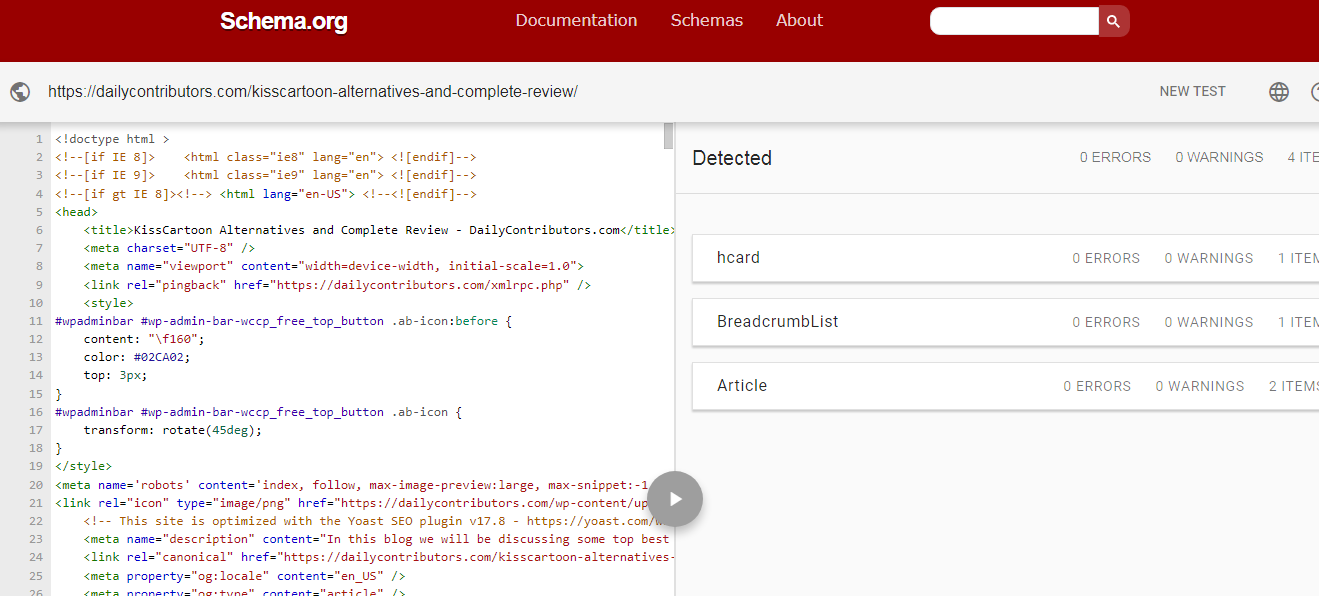
It shows no error
But where as
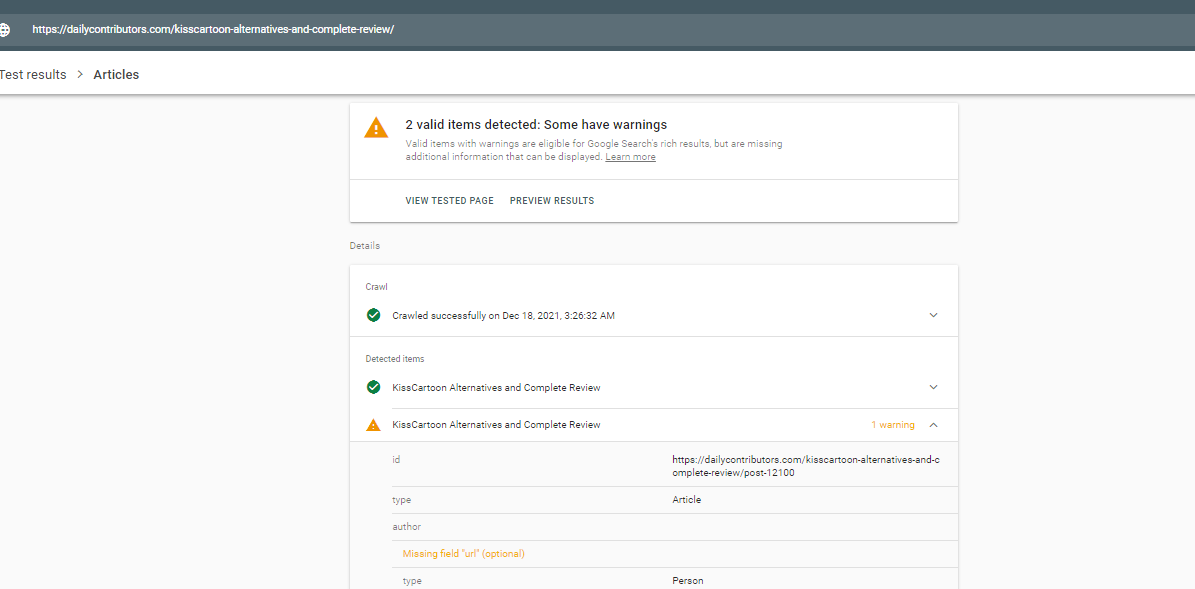
in search central results it gives me a warning "Missing field "url" (optional)".
So is this really be going to issue for my ranking ? Please help thanks!
-
@JoeySolicitor I thinks , My website sam with your issue

Got a burning SEO question?
Subscribe to Moz Pro to gain full access to Q&A, answer questions, and ask your own.
Browse Questions
Explore more categories
-
Moz Tools
Chat with the community about the Moz tools.
-
SEO Tactics
Discuss the SEO process with fellow marketers
-
Community
Discuss industry events, jobs, and news!
-
Digital Marketing
Chat about tactics outside of SEO
-
Research & Trends
Dive into research and trends in the search industry.
-
Support
Connect on product support and feature requests.
Related Questions
-
Unsolved Duplicate LocalBusiness Schema Markup
Hello! I've been having a hard time finding an answer to this specific question so I figured I'd drop it here. I always add custom LocalBusiness markup to clients' homepages, but sometimes the client's website provider will include their own automated LocalBusiness markup. The codes I create often include more information. Assuming the website provider is unwilling to remove their markup, is it a bad idea to include my code as well? It seems like it could potentially be read as spammy by Google. Do the pros of having more detailed markup outweigh that potential negative impact?
Local Website Optimization | | GoogleAlgoServant0 -
Schema Markup Validator vs. Rich Results Test
I am working on a schema markup project. When I test the schema code in the Schema Markup Validator, everything looks fine, no errors detected. However, when I test it in the Rich Results Test, a few errors come back.
Intermediate & Advanced SEO | | Collegis_Education
What is the difference between these two tests? Should I trust one over the other?1 -
Looking for live web examples of Medical schema
Has anyone seen a hospital system or medical clinic properly employ schema markup to their sites? This seems like very new territory, and we want to do it right by our client. Are there any best practices I need to look out for?
Web Design | | Madgenius3 -
SEO advice on ecommerce url structure where categories contain "/c/"
Hi! We use Hybris as plattform and I would like input on which url to choose. We must keep "/c/" before the actual category. c stands for category. I.e. this current url format will be shortened and cleaned:
Technical SEO | | hampgunn
https://www.granngarden.se/Sortiment/Husdjur/Hund/Hundfoder-%26-Hundmat/c/hundfoder To either: a.
https://www.granngarden.se/husdjur/hund/hundfoder/c/hundfoder b.
https://www.granngarden.se/husdjur/hund/c/hundfoder (hundfoder means dogfood) The question is whether we should keep the duplicated category name (hundfoder) before the "/c/" or not. Will there be SEO disadvantages by removing the duplicate "hundfoder" before the "/c/"? I prefer the shorter version ofc, but do not want to jeopardize any SEO rankings or send confusing signals to search engines or customers due to the "/c/" breaking up the url breadcrumb. What do you guys say and prefer from the above alternatives? Thanks /Hampus0 -
Schema markup for products is missing "price": Is this bad?
Hey guys, So a current client of mine has an e-commerce shop with a few hundred products. They purposely choose to keep the prices off of their website, which is causing errors in Google Webmaster Tools. Basically the error shows: Error: Structured Data > Product (markup: schema.org) Error type: missing price 208 items with error Is this a huge deal? Or are we allowed to have non-numerical prices for schema ie. "call for quote"
Technical SEO | | tbinga1 -
New "Static" Site with 302s
Hey all, Came across a bit of an interesting challenge recently, one that I was hoping some of you might have had experience with! We're currently in the process of a website rebuild, for which I'm really excited. The new site is using Markdown to create an entirely static site. Load-times are fantastic, and the code is clean. Life is good, apart from the 302s. One of the weird quirks I've realized is that with oldschool, non-server-generated page content is that every page of the site is an Index.html file in a directory. The resulting in a www.website.com/page-title will 302 to www.website.com/page-title/. My solution off the bat has been to just be super diligent and try to stay on top of the link profile and send lots of helpful emails to the staff reminding them about how to build links, but I know that even the best laid plans often fail. Has anyone had a similar challenge with a static site and found a way to overcome it?
Technical SEO | | danny.wood1 -
NoIndex/NoFollow pages showing up when doing a Google search using "Site:" parameter
We recently launched a beta version of our new website in a subdomain of our existing site. The existing site is www.fonts.com with the beta living at new.fonts.com. We do not want Google to crawl the new site until it's out of beta so we have added the following on all pages: However, one of our team members noticed that google is displaying results from new.fonts.com when doing an "site:new.fonts.com" search (see attached screenshot). Is it possible that Google is indexing the content despite the noindex, nofollow tags? We have double checked the syntax and it seems correct except the trailing "/". I know Google still crawls noindexed pages, however, the fact that they're showing up in search results using the site search syntax is unsettling. Any thoughts would be appreciated! DyWRP.png
Technical SEO | | ChrisRoberts-MTI0 -
How valuable is content "hidden" behind a JavaScript dropdown really?
I've come across a method implemented by some SEO agencies to fill up pages with somehow relevant text and hide it behind a javascript dropdown. Does Google fall for such cheap tricks? You can see this method used on these pages for example (just scroll down to the bottom) - it's all in German, but you get the idea I guess: http://www.insider-boersenbrief.de/ http://www.deko-und-kerzenshop.de/ How is you experience with this way of adding content to a site? Do you think it is valuable or will it get penalised?
Technical SEO | | jfkorn0