Moz Q&A is closed.
After more than 13 years, and tens of thousands of questions, Moz Q&A closed on 12th December 2024. Whilst we’re not completely removing the content - many posts will still be possible to view - we have locked both new posts and new replies. More details here.
MBG Tracker...how to use it?
-
So I am a new blogger that has been submitting guest blog posts to a number of different blogs. It was recommended that I use the MBG Tracker so I can track the back links. The problem is that I am totally lost on how to use this tool. As I said before I am new to this whole thing and I am not really sure what constitutes a "base link" and a "back link." In the author bylines we are linking to different pages within a larger website. If anyone can help me I would really appreciate it!
-
Thanks for the reply Ann! David, SEOmoz and MyBlogGuest are different products, you'll probably find the best help for MBG talking with Ann or using her support forums.
-
Let me try to be very clear. Please email if you have more questions (I got both of your emails, so feel free to use the email)
When guest blogging, are you promoting ONE site in your byline in each of the guest posts? There can be different pages from one site, but one and the same domain.
For example:
- Project name: SEOmoz
- Base domain: seomoz.org
Then when you decide to upload this page, for example: http://www.geekwire.com/2012/seomoz-secret-startup-success-rand-fishkins-tips/ - the tracker will automatically identify the backlink to track - http://www.seomoz.org/dp/seattle-startup-marketing - because it has seomoz.org base domain.
By providing the base domain, you make your own job easier because you don't have to manually provide the tool with the backlink to track!
-
So the base link would be the link to the blog post and the back link is the link that goes back to my site? Is this correct? I had seen the site that you suggested but like I said I was confused by the base link and the back link.
-
Base link is a normal submission with a link. Back link has more value with guest blogging.
HOW DOES THE BACKLINK MONITORING TOOL WORK?
This is the cheapest and simplest alternative I am aware of:
- Receive instant emails if any of your links were removed or nofollowed;
- Track your guest post social popularity (Likes and Tweets)
- Measure traffic from each of your guest posts (for that you’ll need to install a tracking code)
- Identify most efficient backlink sources (for example, to find places where you canguest post again).
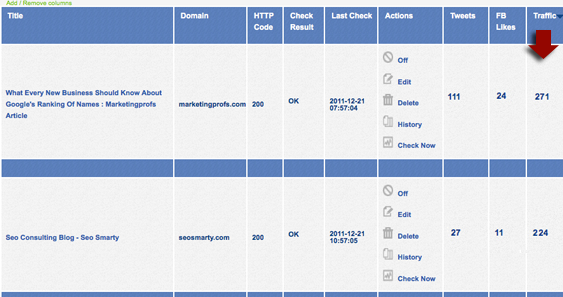
To start tracking your guest posts or links, you’ll need to create a new project and specify your base URL. For all pages you add within one project, this very base URL will be monitored automatically (even if you don’t specify which link within a given page you want to track).
You can add / remove columns from the table (to adjust a clearer view) and sort by each column. You will also receive weekly summaries of your missing links and most popular link sources.
Handy url for more info..... http://www.seosmarty.com/meet-mbg-tracker-the-simplest-and-cheapest-way-to-monitor-your-backlinks/
Got a burning SEO question?
Subscribe to Moz Pro to gain full access to Q&A, answer questions, and ask your own.
Browse Questions
Explore more categories
-
Moz Tools
Chat with the community about the Moz tools.
-
SEO Tactics
Discuss the SEO process with fellow marketers
-
Community
Discuss industry events, jobs, and news!
-
Digital Marketing
Chat about tactics outside of SEO
-
Research & Trends
Dive into research and trends in the search industry.
-
Support
Connect on product support and feature requests.
Related Questions
-
Does using a reverse proxy to make a subdomain appear as a subdirectory affect SEO?
Using a reverse proxy only makes it appear that a subdomain is really a subfolder. However, links in the end remain the same. Does this have any negative (or positive) impact on SEO? Does it make it difficult from the blog's (subdomain's) sitemap or robots.txt file to be properly read by search engines?
Technical SEO | | rodelmo41 -
Can you use Screaming Frog to find all instances of relative or absolute linking?
My client wants to pull every instance of an absolute URL on their site so that they can update them for an upcoming migration to HTTPS (the majority of the site uses relative linking). Is there a way to use the extraction tool in Screaming Frog to crawl one page at a time and extract every occurrence of _href="http://" _? I have gone back and forth between using an x-path extractor as well as a regex and have had no luck with either. Ex. X-path: //*[starts-with(@href, “http://”)][1] Ex. Regex: href=\”//
Technical SEO | | Merkle-Impaqt0 -
Is it better to use XXX.com or XXX.com/index.html as canonical page
Is it better to use 301 redirects or canonical page? I suspect canonical is easier. The question is, which is the best canonical page, YYY.com or YYY.com/indexhtml? I assume YYY.com, since there will be many other pages such as YYY.com/info.html, YYY.com/services.html, etc.
Technical SEO | | Nanook10 -
Is it ok to use H1 tags in breadcrumbs?
A client has an e-commerce site and she doesn't want a page title on the products page. She has breadcrumbs though. Her website developer suggests putting the H1 on the breadcrumbs. So: products> Gifts > picture frame with h1 tags round the word "picture frame". Is this ok to do? Or is it a bad thing for SEO purposes? Thanks
Technical SEO | | AL123al0 -
Using a non-visible H1
I have a developer that wants to use style="text-indent:-9999px" to make the H1 non-visible to the user. Being the conservative person I am, I've never tried this before and worry that Search Engines may think this is a form of cloaking. Am I worrying about nothing? And apologies if it's already been covered here. I couldn't find it. Thanks in advance!!!!
Technical SEO | | elytical0 -
OK to block /js/ folder using robots.txt?
I know Matt Cutts suggestions we allow bots to crawl css and javascript folders (http://www.youtube.com/watch?v=PNEipHjsEPU) But what if you have lots and lots of JS and you dont want to waste precious crawl resources? Also, as we update and improve the javascript on our site, we iterate the version number ?v=1.1... 1.2... 1.3... etc. And the legacy versions show up in Google Webmaster Tools as 404s. For example: http://www.discoverafrica.com/js/global_functions.js?v=1.1
Technical SEO | | AndreVanKets
http://www.discoverafrica.com/js/jquery.cookie.js?v=1.1
http://www.discoverafrica.com/js/global.js?v=1.2
http://www.discoverafrica.com/js/jquery.validate.min.js?v=1.1
http://www.discoverafrica.com/js/json2.js?v=1.1 Wouldn't it just be easier to prevent Googlebot from crawling the js folder altogether? Isn't that what robots.txt was made for? Just to be clear - we are NOT doing any sneaky redirects or other dodgy javascript hacks. We're just trying to power our content and UX elegantly with javascript. What do you guys say: Obey Matt? Or run the javascript gauntlet?0 -
Using hyphenated sub-domains or non-hyphenated sub-domains? What is the question! I Any takers?
For our corporate business level domain, we are exploring using a hyphenated sub-domain foir a project. Something like www.go-figure.extreme.com I thought from a user perspective it seems cluttered. The domain length might also be an issue with the new Algorithm big G has launched in recent past. I know with past experience, hyphenated domains usually take longer to index, as they are used by spammers more frequently and can take longer to get out of the supplementary index. Our company site has over 90 million viewers / year, so our brand is well established and traffic isn't an issue. This is for a corporate level project and I didn't have the answer! Will this work? anyone have any experience testing this. Any thoughts will help! Thanks, Rob
Technical SEO | | RobMay0 -
Should we use Google's crawl delay setting?
We’ve been noticing a huge uptick in Google’s spidering lately, and along with it a notable worsening of render times. Yesterday, for example, Google spidered our site at a rate of 30:1 (google spider vs. organic traffic.) So in other words, for every organic page request, Google hits the site 30 times. Our render times have lengthened to an avg. of 2 seconds (and up to 2.5 seconds). Before this renewed interest Google has taken in us we were seeing closer to one second average render times, and often half of that. A year ago, the ratio of Spider to Organic was between 6:1 and 10:1. Is requesting a crawl-delay from Googlebot a viable option? Our goal would be only to reduce Googlebot traffic, and hopefully improve render times and organic traffic. Thanks, Trisha
Technical SEO | | lzhao0