Moz Q&A is closed.
After more than 13 years, and tens of thousands of questions, Moz Q&A closed on 12th December 2024. Whilst we’re not completely removing the content - many posts will still be possible to view - we have locked both new posts and new replies. More details here.
Page Indexing without content
-
Hello.
I have a problem of page indexing without content. I have website in 3 different languages and 2 of the pages are indexing just fine, but one language page (the most important one) is indexing without content. When searching using site: page comes up, but when searching unique keywords for which I should rank 100% nothing comes up.
This page was indexing just fine and the problem arose couple of days ago after google update finished. Looking further, the problem is language related and every page in the given language that is newly indexed has this problem, while pages that were last crawled around one week ago are just fine.
Has anyone ran into this type of problem?
-
I've encountered a similar indexing issue on my website, https://sunasusa.com/. To resolve it, ensure that the language markup and content accessibility on the affected pages are correct. Review any recent changes and the quality of your content. Utilize Google Search Console for insights, or consider reaching out to Google support for assistance.
-
To remove hacked URLs in bulk from Google's index, clean up your website, secure it, and then use Google Search Console to request removal of the unwanted URLs. Additionally, submit a new sitemap containing only valid URLs to expedite re-indexing.
-
It seems that after a recent Google update, one language version of your website is experiencing indexing issues, while others remain unaffected. This could be due to factors like changes in algorithms or technical issues. To address this:
- Check h reflag tags and content quality.
- Review technical aspects like crawlability and indexing directives. Deck Services in Duluth GA
- Monitor Google Search Console for errors.
- Consider seeking expert assistance if needed.
-
@AtuliSulava Re: Website blog is hacked. Whats the best practice to remove bad urls
something similar problem also happened to me. many urls are indexed but they have no content in actual. My website(scaleme) was hacked and thousands of URLs with Japanese content were added to my site. These URLs are now indexed by Google. How can I remove them in bulk? (ScreenShoot attached)
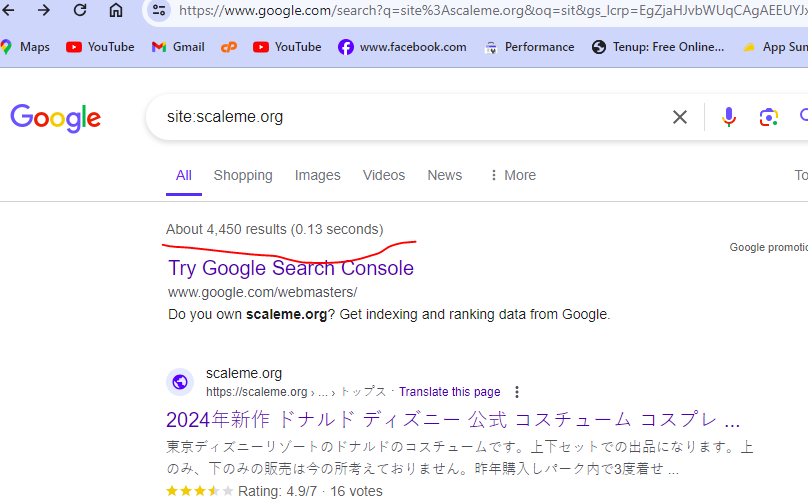
I am the owner of this website. thousands of Japanese-language URLs (more than 4400) were added to my site. i am aware with google url remover tool but adding one by one url and submitting for removing is not possible because there are large number of url indexed by google.
Is there a way to find these url , downlaod a list and remove these URLs in bulk? is Moz have any tool to solve this problem?
-
I've faced a similar indexing issue on my website https://mobilespackages.in/ myself. To resolve it, ensure correct language markup and content accessibility on the affected pages. Review recent changes and content quality. Utilize Google Search Console for insights or reach out to Google support.
-
@AtuliSulava It sounds like you're experiencing a frustrating issue with your website's indexing. I have faced this issue. Unfortunately, I have prevented my website from indexing in google by mistake. Here are some steps you can take to troubleshoot and potentially resolve the problem:
Check Robots.txt: Ensure that your site's robots.txt file is not blocking search engine bots from accessing the content on the affected pages.
Review Meta Tags: Check the <meta name="robots" content="noindex"> tag on the affected pages. If present, remove it to allow indexing.
Content Accessibility: Make sure that the content on the affected pages is accessible to search engine bots. Check for any JavaScript, CSS, or other elements that might be blocking access to the content.
Canonical Tags: Verify that the canonical tags on the affected pages are correctly pointing to the preferred version of the page.
Structured Data Markup: Ensure that your pages have correct structured data markup to help search engines understand the content better.
Fetch as Google: Use Google Search Console's "Fetch as Google" tool to see how Googlebot sees your page and if there are any issues with rendering or accessing the content.
Monitor Google Search Console: Keep an eye on Google Search Console for any messages or issues related to indexing and crawlability of your site.
Wait for Re-crawl: Sometimes, Google's indexing issues resolve themselves over time as the search engine re-crawls and re-indexes your site. If the problem persists, consider requesting a re-crawl through Google Search Console.
If the issue continues, it might be beneficial to seek help from a professional SEO consultant who can perform a detailed analysis of your website and provide specific recommendations tailored to your situation. -
@AtuliSulava Perhaps indexing of blank pages is prohibited on this site, look for more information on how to check the ban on indexing in which site files...
Got a burning SEO question?
Subscribe to Moz Pro to gain full access to Q&A, answer questions, and ask your own.
Browse Questions
Explore more categories
-
Moz Tools
Chat with the community about the Moz tools.
-
SEO Tactics
Discuss the SEO process with fellow marketers
-
Community
Discuss industry events, jobs, and news!
-
Digital Marketing
Chat about tactics outside of SEO
-
Research & Trends
Dive into research and trends in the search industry.
-
Support
Connect on product support and feature requests.
Related Questions
-
Spam on Google SEO
Do you know any good tips to reduce spam and if spams have an on google ranking?
SEO Tactics | | easyjobber0 -
Duplicate Content on a Page Due to Responsive Version
What are the implications if a web designer codes the content of the site twice into the page in order to make the site responsive? I can't add the url I'm afraid but the H1 and the content appear twice in the code in order to produce both a responsive version and a desktop version. This is a Wordpress site. Is Google clever enough to distinguish between the 2 versions and treat them individually? Or will Google really think that the content has been repeated on the same page?
Technical SEO | | Wagada0 -
Upgrade old sitemap to a new sitemap index. How to do without danger ?
Hi MOZ users and friends. I have a website that have a php template developed by ourselves, and a wordpress blog in /blog/ subdirectory. Actually we have a sitemap.xml file in the root domain where are all the subsections and blog's posts. We upgrade manually the sitemap, once a month, adding the new posts created in the blog. I want to automate this process , so i created a sitemap index with two sitemaps inside it. One is the old sitemap without the blog's posts and a new one created with "Google XML Sitemap" wordpress plugin, inside the /blog/ subdirectory. That is, in the sitemap_index.xml file i have: Domain.com/sitemap.xml (old sitemap after remove blog posts urls) Domain.com/blog/sitemap.xml (auto-updatable sitemap create with Google XML plugin) Now i have to submit this sitemap index to Google Search Console, but i want to be completely sure about how to do this. I think that the only that i have to do is delete the old sitemap on Search Console and upload the new sitemap index, is it ok ?
Technical SEO | | ClaudioHeilborn0 -
How to block text on a page to be indexed?
I would like to block the spider indexing a block of text inside a page , however I do not want to block the whole page with, for example , a noindex tag. I have tried already with a tag like this : chocolate pudding chocolate pudding However this is not working for my case, a travel related website. thanks in advance for your support. Best regards Gianluca
Technical SEO | | CharmingGuy0 -
Should I put meta descriptions on pages that are not indexed?
I have multiple pages that I do not want to be indexed (and they are currently not indexed, so that's great). They don't have meta descriptions on them and I'm wondering if it's worth my time to go in and insert them, since they should hypothetically never be shown. Does anyone have any experience with this? Thanks! The reason this is a question is because one member of our team was linking to this page through Facebook to send people to it and noticed random text on the page being pulled in as the description.
Technical SEO | | Viewpoints0 -
How Does Google's "index" find the location of pages in the "page directory" to return?
This is my understanding of how Google's search works, and I am unsure about one thing in specific: Google continuously crawls websites and stores each page it finds (let's call it "page directory") Google's "page directory" is a cache so it isn't the "live" version of the page Google has separate storage called "the index" which contains all the keywords searched. These keywords in "the index" point to the pages in the "page directory" that contain the same keywords. When someone searches a keyword, that keyword is accessed in the "index" and returns all relevant pages in the "page directory" These returned pages are given ranks based on the algorithm The one part I'm unsure of is how Google's "index" knows the location of relevant pages in the "page directory". The keyword entries in the "index" point to the "page directory" somehow. I'm thinking each page has a url in the "page directory", and the entries in the "index" contain these urls. Since Google's "page directory" is a cache, would the urls be the same as the live website (and would the keywords in the "index" point to these urls)? For example if webpage is found at wwww.website.com/page1, would the "page directory" store this page under that url in Google's cache? The reason I want to discuss this is to know the effects of changing a pages url by understanding how the search process works better.
Technical SEO | | reidsteven750 -
"nofollow pages" or "duplicate content"?
We have a huge site with lots of geographical-pages in this structure: domain.com/country/resort/hotel domain.com/country/resort/hotel/facts domain.com/country/resort/hotel/images domain.com/country/resort/hotel/excursions domain.com/country/resort/hotel/maps domain.com/country/resort/hotel/car-rental Problem is that the text on ie. /excursions is often exactly the same on .../alcudia/hotel-sea-club/excursion and .../alcudia/hotel-beach-club/excursion The two hotels offer the same excursions, and the intro text on the pages are the exact same throughout the entire site. This is also a problem on the /images and /car-rental pages. I think in most cases the only difference on these pages is the Title, description and H1. These pages do not attract a lot of visits through search-engines. But to avoid them being flagged as duplicate content (we have more than 4000 of these pages - /excursions, /maps, /car-rental, /images), do i add a nofollow-tag to these, do i block them in robots.txt or should i just leave them and live with them being flagged as duplicate content? Im waiting for our web-team to add a function to insert a geographical-name in the text, so i could add ie #HOTELNAME# in the text and thereby avoiding the duplicate text. Right now we have intros like: When you visit the hotel ... instead of: When you visit Alcudia Sea Club But untill the web-team has fixed these GEO-tags, what should i do? What would you do and why?
Technical SEO | | alsvik0