Moz Q&A is closed.
After more than 13 years, and tens of thousands of questions, Moz Q&A closed on 12th December 2024. Whilst we’re not completely removing the content - many posts will still be possible to view - we have locked both new posts and new replies. More details here.
Sudden Drop in Mobile Core Web Vitals
-
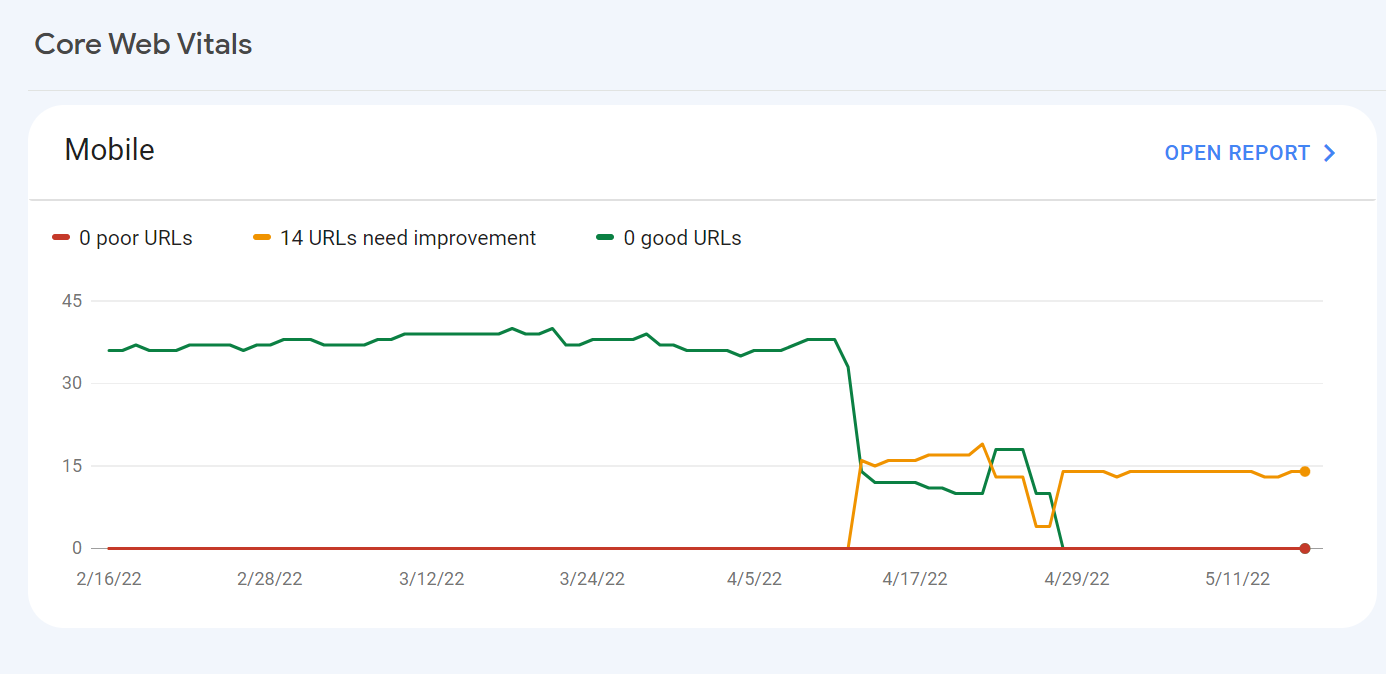
For some reason, after all URLs being previously classified as Good, our Mobile Web Vitals report suddenly shifted to the above, and it doesn't correspond with any site changes on our end.
Has anyone else experience something similar or have any idea what might have caused such a shift?
Curiously I'm not seeing a drop in session duration, conversion rate etc. for mobile traffic despite the seemingly sudden change.
-
I can’t understand their algorithm for core web vitals. I have made some technical updates to our website for speed optimization, but the thing that happened in the search console is very confusing for my site.
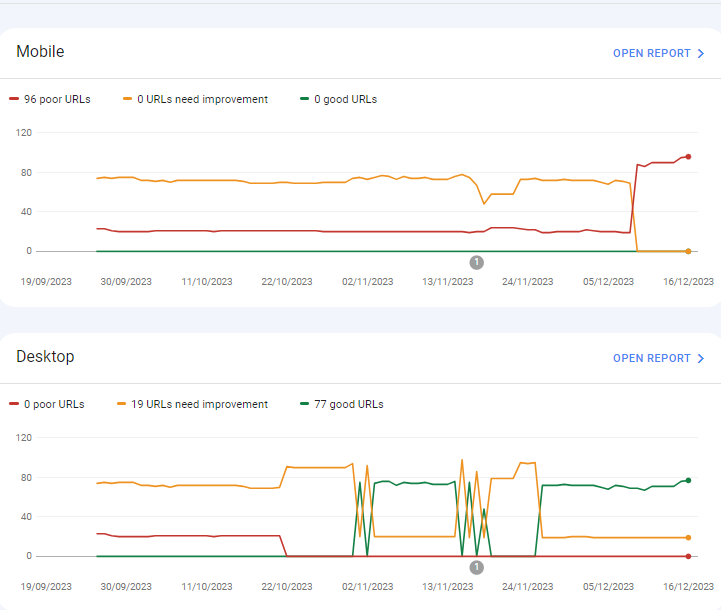
For desktops, pages are indexed as good URLs
while mobile-indexed URLs are displayed as poor URLs.
Our website is the collective material for people looking for Canada immigration (PAIC), and 70% of the portion is filled with text only. We are using webp images for optimization, still it is not passing Core Web Vitals.I am looking forward to the expert’s suggestion to overcome this problem.
-
I can’t understand their algorithm for core web vitals. I have made some technical updates to our website for speed optimization, but the thing that happened in the search console is very confusing for my site.
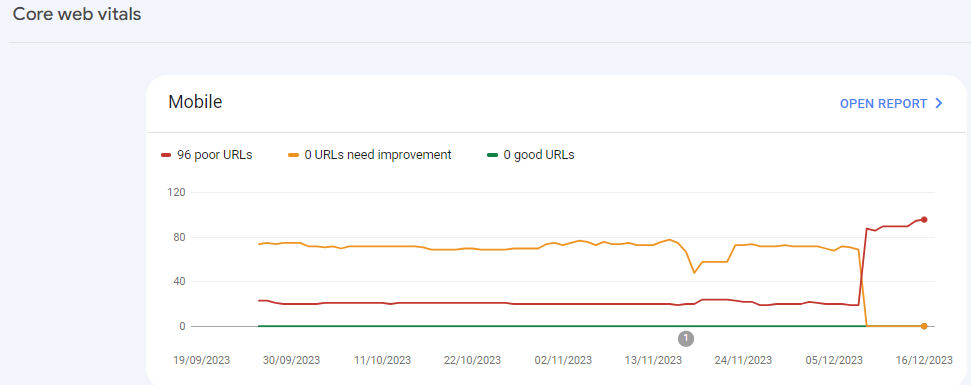
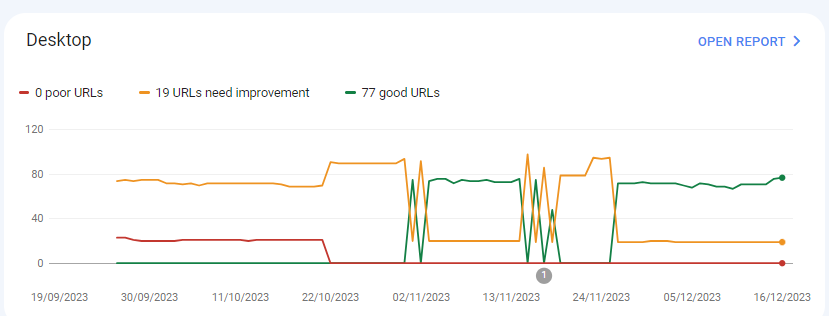
For desktops, pages are indexed as good URLs
while mobile-indexed URLs are displayed as poor URLs.
Our website is the collective material for people looking for Canadian immigration (PAIC), and 70% of the portion is filled with text only. We are using webp images for optimization, still it is not passing Core Web Vitals.I am looking forward to the expert’s suggestion to overcome this problem.
-
@rwat Hi, did you find a solution?
-
Yes, I am also experiencing the same for one of my websites, but most of them are blog posts and I am using a lot of images without proper optimization, so that could be the reason. but not sure.
It is also quite possible that Google maybe adding some more parameters to their main web critical score.
Got a burning SEO question?
Subscribe to Moz Pro to gain full access to Q&A, answer questions, and ask your own.
Browse Questions
Explore more categories
-
Moz Tools
Chat with the community about the Moz tools.
-
SEO Tactics
Discuss the SEO process with fellow marketers
-
Community
Discuss industry events, jobs, and news!
-
Digital Marketing
Chat about tactics outside of SEO
-
Research & Trends
Dive into research and trends in the search industry.
-
Support
Connect on product support and feature requests.
Related Questions
-
Google News and Discover down by a lot
Hi,
Technical SEO | | SolenneGINX
Could you help me understand why my website's Google News and Discover Performance dropped suddenly and drastically all of a sudden in November? numbers seem to pick up a little bit again but nowhere close what we used to see before then0 -
Solved How to solve orphan pages on a job board
Working on a website that has a job board, and over 4000 active job ads. All of these ads are listed on a single "job board" page, and don’t obviously all load at the same time. They are not linked to from anywhere else, so all tools are listing all of these job ad pages as orphans. How much of a red flag are these orphan pages? Do sites like Indeed have this same issue? Their job ads are completely dynamic, how are these pages then indexed? We use Google’s Search API to handle any expired jobs, so they are not the issue. It’s the active, but orphaned pages we are looking to solve. The site is hosted on WordPress. What is the best way to solve this issue? Just create a job category page and link to each individual job ad from there? Any simpler and perhaps more obvious solutions? What does the website structure need to be like for the problem to be solved? Would appreciate any advice you can share!
Reporting & Analytics | | Michael_M2 -
Reducing cumulative layout shift for responsive images - core web vitals
In preparation for Core Web Vitals becoming a ranking factor in May 2021, we are making efforts to reduce our Cumulative Layout Shift (CLS) on pages where the shift is being caused by images loading. The general recommendation is to specify both height and width attributes in the html, in addition to the CSS formatting which is applied when the images load. However, this is problematic in situations where responsive images are being used with different aspect ratios for mobile vs desktop. And where a CMS is being used to manage the pages with images, where width and height may change each time new images are used, as well as aspect ratios for the mobile and desktop versions of those. So, I'm posting this inquiry here to see what kinds of approaches others are taking to reduce CLS in these situations (where responsive images are used, with differing aspect ratios for desktop and mobile, and where a CMS allows the business users to utilize any dimension of images they desire).
Web Design | | seoelevated3 -
Breadcrumbs on Mobile How important are they for SEO?
Due to Poor unsightly look of breadcrumbs and the space it takes up above the fold we only employ breadcrumbs on our desktop version. Breadcrumbs are hidden from view on mobile version. However as mobile first indexing is now in play what technical SEO impacts will this have? one thing that comes to mind is crawling deeper pages where breadcrumbs made them accessible in less than 3 link clicks? But i am unsure now of the impacts of not having breadcrumbs visible for mobile version of our site.
Technical SEO | | oceanstorm0 -
Best Web-site Structure/ SEO Strategy for an online travel agency?
Dear Experts! I need your help with pointing me in the right direction. So far I have found scattered tips around the Internet but it's hard to make a full picture with all these bits and pieces of information without a professional advice. My primary goal is to understand how I should build my online travel agency web-site’s (https://qualistay.com) structure, so that I target my keywords on correct pages and do not create a duplicate content. In my particular case I have very similar properties in similar locations in Tenerife. Many of them are located in the same villa or apartment complex, thus, it is very hard to come up with the unique description for each of them. Not speaking of amenities and pricing blocks, which are standard and almost identical (I don’t know if Google sees it as a duplicate content). From what I have read so far, it’s better to target archive pages rather than every single property. At the moment my archive pages are: all properties (includes all property types and locations), a page for each location (includes all property types). Does it make sense adding archive pages by property type in addition OR in stead of the location ones if I, for instance, target separate keywords like 'villas costa adeje' and 'apartments costa adeje'? At the moment, the title of the respective archive page "Properties to rent in costa adeje: villas, apartments" in principle targets both keywords... Does using the same keyword in a single property listing cannibalize archive page ranking it is linking back to? Or not, unless Google specifically identifies this as a duplicate content, which one can see in Google Search Console under HTML Improvements and/or archive page has more incoming links than a single property? If targeting only archive pages, how should I optimize them in such a way that they stay user-friendly. I have created (though, not yet fully optimized) descriptions for each archive page just below the main header. But I have them partially hidden (collapsible) using a JS in order to keep visitors’ focus on the properties. I know that Google does not rank hidden content high, at least at the moment, but since there is a new algorithm Mobile First coming up in the near future, they promise not to punish mobile sites for a collapsible content and will use mobile version to rate desktop one. Does this mean I should not worry about hidden content anymore or should I move the descirption to the bottom of the page and make it fully visible? Your feedback will be highly appreciated! Thank you! Dmitry
Technical SEO | | qualistay1 -
Fixing a website redirect situation that resulted in drop in traffic
Hi, I'm trying to help someone fix the following situation: they had a website, www.domain.com, that was generating a steady amount of traffic for three years. They then redesigned the website a couple of months ago, and the website developer redirected the site to domain.com but did not set up analytics on domain.com. We noticed that there was a drop in traffic to www.domain.com but have no idea if domain.com is generating any traffic since analytics wasn't installed. To fix this situation, I was going to find out from the developer if there was a good reason to redirect the site. What would have prompted the developer to do this if www.domain.com had been used already for three years? Then, unless there was a good reason, I would change the redirect back to what it was before - domain.com redirecting to www.domain.com. Presumably this would allow us to regain the traffic to the site www.domain.com that was lost when the redirect was put in place. Does this sound like a reasonable course of action? Is there anything that I'm missing, or anything else that I should do in this situation? Thanks in advance! Carolina
Technical SEO | | csmm0 -
Google Impressions Drop Due to Expired SSL
Recently I noticed a huge drop in our clients Google Impressions via GWMT from 900 impressions to 70 overnight on October 30, 2012 and has remained this way for the entire month of November 2012. The SSL Cert had expired in mid October due to the notification message for renewal going to the SPAM folder and being missed. Is it possible for an SSL expiry to be related to this massive drop in daily impressions which in-turn has also effected traffic? I also can't see any evidence of duplicate pages (ie. https and http) being indexed but to be honest I'm not the one doing the SEO therefore haven't been tracking this. Thanks for your help! Chris
Technical SEO | | MeMediaSEO0